



By: Hana Hanifah, 2025 Valentine-Cosman Research Fellow
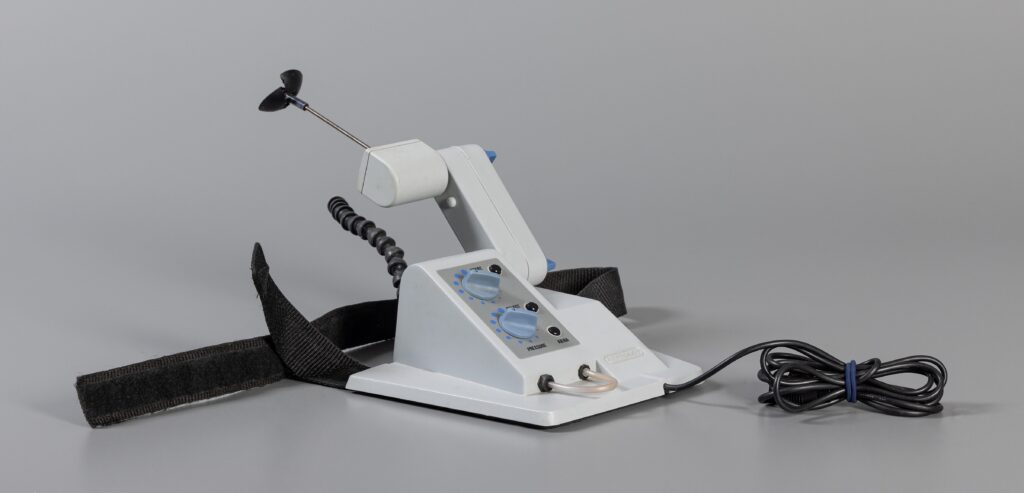
In recent years, the momentum for accessibility in games has gained significant traction. Many custom configurations, such as captions, remappable controls, and adaptable hardware, are becoming the norm as more people, especially those with disabilities, play and engage in games. The Xbox Adaptive Controller and the PS5’s Access Controller have been rightly praised and documented in the mainstream media (e.g., Forbes, Wired,Time). However, decades before they emerged, Nintendo of America released its own adaptive device. In 1989, Nintendo of America began selling the Handsfree Controller, an adaptive device for players who could not use a standard NES controller due to limited mobility or insufficient hand function. The company’s own order form specified what the device required in return: good motor control of the jaw or head, and moderate lung capacity. It is little remembered today. As part of my research on accessibility, I took a trip to The Strong National Museum of Play in Rochester, New York, one of the few places this rare artifact can still be found.
In the history of gaming, accessibility innovation has come from many directions at once: from disabled players and their families, from independent engineers, from advocacy organizations, and, at times, from the companies themselves. Long before “inclusivity” became a corporate term, disabled gamers modified their own hardware, shared Do-It-Yourself (DIY) documentation through newsletters and user groups, and built communities of practice around accessible play (e.g. John Dutton’s accessible Atari CX40 Joystick). Independent developers were making accessible games in the same period. Working as Yakety Yak Software for the Blind, David Calderwood produced speech and audio versions of arcade and card games for blind players on the VIC-20 and BBC Micro through the 1980s, including an audio Pac-Man and a backgammon game supplied with a tactile board. His work was documented across mainstream computing magazines and channels aimed at blind readers themselves, including audio cassette publications and St. Dunstan’s Review.
Independent engineers also played a foundational role, sometimes with corporate encouragement. The most frequently cited figure is Ken Yankelevitz, an aerospace engineer who began building mouth-operated controllers in 1981 after Atari referred him to a teenager with quadriplegia who wanted to play video games. After the Atari project, Yankelevitz was then asked to help at a rehabilitation hospital in Downey, CA, where he met Kirk Kilgour, a former collegiate athlete and quadriplegic who had been trying to find someone to build him a joystick so he could still compete using video games. Yankelevitz and Kilgour collaborated to build something that worked for him, and that the hospital’s children’s recreation therapy department took up as well. This collaboration between an engineer and disabled people shows that the design brief did not begin with an assumption about what a disabled person might need: it began with a goal Kilgour had defined for himself. Yankelevitz went on to hand-build and repair adaptive controllers for decades through his company, KY Enterprises, selling them at prices that barely covered the cost of parts. His sip-and-puff controller for the Atari 2600 was featured in video game magazines as early as 1983. Atari itself supported accessibility in other ways during its heyday, from its Special Feature labeling and easier play options to its sponsorship of the Special Olympics. Corporations were rarely the primary engine of this history, but they were not absent from it either. A few years later, in 1983, John Dutton’s innovation for an accessible controller was featured in the February 1983 issue of the Atari VCS Owners Club Bulletin in the United Kingdom (U.K.). As a passionate gamer with muscular dystrophy, Dutton crafted his own, low-tech adaptive joystick to continue playing Pac-Man and compete for high scores. The two worked in different registers: Yankelevitz built for others as a sustained practice, while Dutton adapted his own equipment and published what he had made so that others might copy it. Both introduced alternative input methods that enabled players with limited mobility to access commercial gaming systems.
How that work was documented, however, is a different question from how much of it existed. In general-interest publications, gaming and disability tended to be framed medically: articles emphasized the rehabilitative benefits of the medium, particularly in the context of occupational therapy, rather than treating play as a cultural process and a fundamental right. That framing was a tendency rather than a rule, and it was strongest in the mainstream press. Accounts centered on pleasure did exist, but they tended to circulate in enthusiast and community venues. A 1984 Electronic Games piece profiled Felix Pagan, a blind New Yorker who played Dragon’s Lair and Space Ace by audio cues at a Manhattan arcade, simply because he loved the games. Calderwood’s writing reached readers through computing magazines and channels made for blind audiences. The question, then, is less whether disabled players were written about than where those accounts could be found. Against this backdrop, in 1987, one of the largest gaming companies began developing its own adaptive controller.
A Mother’s Letter and Nintendo’s Reply
The origins of Nintendo’s Handsfree Controller can be traced back to a letter that was neither an ordinary letter nor an inconsequential request. A mother from Oklahoma wrote to Nintendo of America to ask whether there was any possible way her disabled child might play video games like every other child. Instead of disregarding her request or responding with a form letter, Nintendo decided to engage. The company partnered with Seattle Children’s Hospital and received support from the National Spinal Cord Injury Association to develop an adaptive controller that could be operated hands-free.
It took nearly two years to develop the Handsfree Controller, with engineers and medical professionals involved, but largely motivated by the people Nintendo referred to as self-advocates. The first commercial production run came in April 1989. The technology included several key features. Most notably, it supported a gamer without requiring physical hand use: the controller was operated with a chin joystick for directional movement, included sip-and-puff inputs that simulated button presses, and used straps wrapped around the player’s shoulders to hold the unit securely against the body.
The Handsfree Controller sold for $120, one and a half times the cost of the Nintendo Entertainment System (N.E.S.) console ($79.99) in 1989. Some of that price reflected the realities of a comparatively complex, specialized, low-volume device, and community-made alternatives existed at lower cost. For example, the Trace Resource Book, a major assistive technology directory, listed KY Enterprises’ Mouth Operated Joystick for Nintendo at $85, a device that appears to have reached the market before Nintendo’s official unit. Even so, the Handsfree Controller was expensive relative to the console it served. Unlike other Nintendo peripherals, it could not be purchased in stores. Players had to call Nintendo’s customer service line and order one directly from the company.
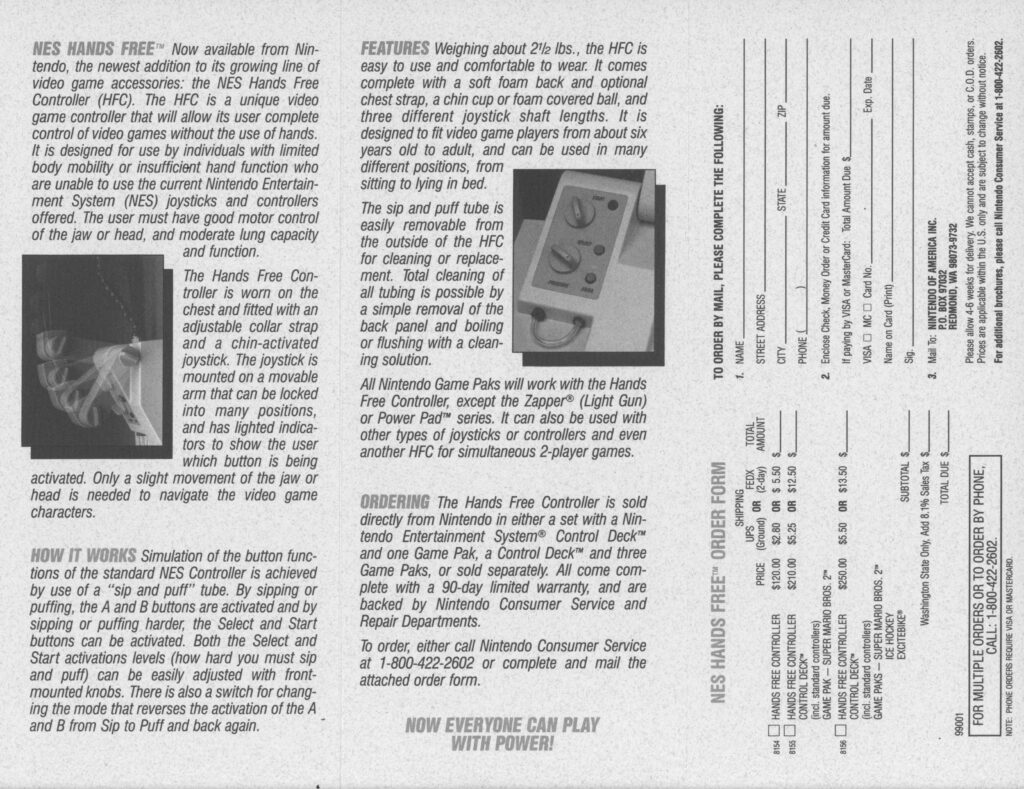
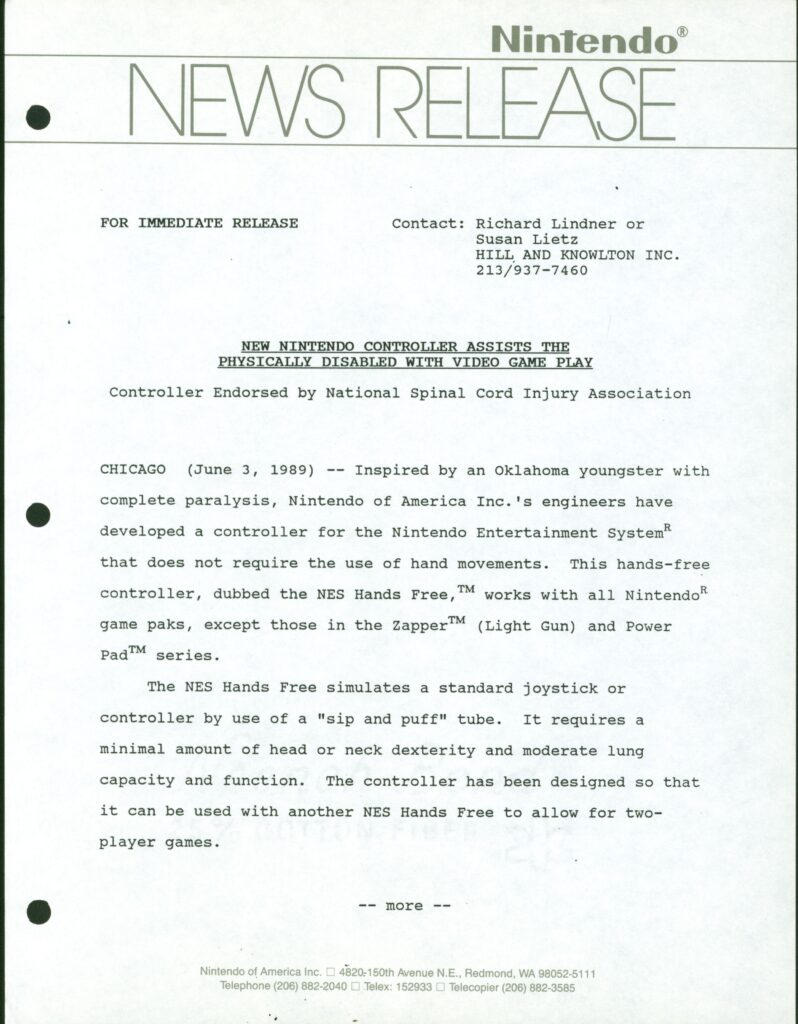
A June 3, 1989, press release issued by Nintendo excitedly proclaimed: “New Nintendo Controller Assists the Physically Disabled with Video Game Play.” The press release detailed the controller’s innovative functionality, collaborative design process, and direct ordering procedure, and highlighted that it was officially endorsed by the National Spinal Cord Injury Association.
When I first researched this post, working from materials available online and within the museum’s archive, the Handsfree Controller appeared almost entirely absent from the contemporary media record. Community researchers have since demonstrated that its visibility was considerably wider than any single archive suggests. Nintendo promoted the controller at the 1988 Winter Consumer Electronics Show (C.E.S.) and 1989 Summer C.E.S. trade shows, where it drew coverage from Famitsu magazine in Japan and ACE (Advanced Computer Entertainment) magazine in the U.K.. It appeared in Nintendo Power, the December 1990 issue of Boys’ Life, the January 1991 issue of Compute, and GamePro issue 17. It was listed in the Trace Resource Book, a significant placement for assistive technology, across four years from 1991 to 1994. It won a silver award from the Industrial Designers Society of America. Perhaps most visibly of all, it was promoted as part of the 1990 Nintendo World Championships, a touring competition and exhibit that traveled across the United States, complete with equipped play stations and a prominent article in the tour’s Insider’s Guide.
What remains true, and what I think remains telling, is where the controller did not appear: in mainstream retail advertising. Nintendo’s own “World of Nintendo” ads featured fairly comprehensive pictures of controller accessories, but not the Handsfree Controller, and I have not found it in the retailer ads or store circulars I examined. Its visibility was concentrated in trade shows, specialty publications, and assistive technology directories rather than in the retail channels through which most families encountered Nintendo products. In other words, the controller was legible to the assistive technology world and largely illegible to the ordinary shopper. That pattern says something more precise, and I would argue more interesting, about how the industry conceived of accessibility in the late 1980s than a simple story of silence.
A Small Market but Not an Empty One
The direct-only distribution model shaped who could find the device, but the evidence suggests it did travel. According to the 1990 Nintendo World Championships Insider’s Guide, more than 100 units were sold to players across the United States within roughly a year of release. The controller was also exported: a 1989 interview in the French magazine Micro News records Nintendo’s Ron Judy announcing that the Handsfree Controller would be available in France for Christmas, that Nintendo would donate units free of charge to several French hospitals, and that the company made no profit on the accessory. Judy described being present when the controllers were distributed at a hospital as one of the most moving moments of his life. Units appear to have reached Japan as well, and it seems likely that some found their way into rehabilitation hospitals and day centers, settings where adaptive gaming hardware had circulated since well before 1987. The total number sold remains unknown, and this is precisely the kind of question that corporate archives, if opened, might answer.
One frequent modern criticism deserves careful handling. It is true that no NES game is known to have been developed specifically for the Handsfree Controller. However, comparing today’s accessibility initiatives, where hardware and software teams work almost concurrently, can be misleading. The Handsfree Controller was designed to give a player access to every input on a standard NES controller. Because the NES control scheme was relatively simple, effectively eight buttons, a great many games were substantially playable with the device by default. Certain actions, such as pressing A and B simultaneously, posed real difficulties, and there is no evidence that developers designed around the device’s constraints. Yet the gap between an NES pad and the controller was far narrower than the gap a modern adaptive device must bridge with a DualSense or a motion controller. The software side of accessibility, as we now understand it, was a problem that this era had barely begun to formulate.
A Quiet Legacy
While modern accessibility initiatives involve companies designing entire systems around principles of inclusive design, Nintendo’s subsequent record was thinner, though not empty. Nintendo of America does not appear to have released another first-party adaptive controller. The company did, however, later support Pathways Development Group in creating the Team Xtreme range of switch accessible hardware for its consoles, and reportedly supported Sound Voyager, a game demonstrated as playable blind. There is also no strong evidence that Nintendo of Japan drove or acknowledged the Handsfree project, which suggests the effort likely originated with the American division’s response to the original letter. Nintendo’s corporate history does, at least, record the Hands-Free controller in its N.E.S.-era timeline.
The co-design process with Seattle Children’s Hospital and the National Spinal Cord Injury Association remains genuinely notable, though it did not invent the practice. Engineers in this space had long worked closely with the people they built for. For example, Yankelevitz had constructed custom controllers tailored to each client’s personal needs for decades, and assistive technology pioneers such as Reg Maling had been co-designing with disabled users since the 1960s. What the Handsfree Controller represents is a large corporation adopting, at scale and with institutional partners, a collaborative approach that the community had already modeled.
Was the project a failure? I am no longer sure that is the right frame. The addressable market was small, at least a hundred units had reached players within roughly a year, and Nintendo stated it took no profit on the device. It may be more accurate to say that the Handsfree Controller did a modest job of serving a modest market, and that what failed to materialize was continuity, or a sustained institutional commitment that would carry the lessons of 1989 forward rather than leaving each subsequent effort to begin again.
The Nintendo Handsfree Controller was an early and significant corporate step toward accessible gaming, though not the first and not taken in isolation. Atari’s referrals and sponsorships preceded it, and independent engineers like Yankelevitz reached the NES market before Nintendo’s official unit, at a fraction of the price. Indeed, it is worth noting that Yankelevitz is understood to have approached Nintendo before the Handsfree Controller existed, urging the company to make accessible controllers like his. The Handsfree Controller existed, it worked, and for the players who had one, it opened up new experiences in digital play.
It didn’t transform the world of gaming, but it made the medium a little more inviting. It gave disabled gamers a rare moment of visibility from a major corporation and laid another small piece of a gigantic, unfinished set of stones on a path toward truly inclusive gaming.
What This Episode Teaches About Doing This History
This little piece of history raises important questions that remain relevant today. What evidence of past accessibility innovations sits in corporate archives? What has disappeared from corporate histories because the clues are buried in internal memos and product catalogs? What would the gaming landscape look like if early attempts such as the Handsfree Controller had been backed and resourced for sustained development? Most importantly, what can we learn from both the successes and the limitations of these early endeavors as the industry works to serve all players?
To those questions, I would now add one more, prompted by the revision of this very post: where does the history of accessible gaming actually live? My original research drew on the materials available online and within the museum’s archive, and the picture those sources produced was incomplete in instructive ways. Much of the evidence that fills in the gaps, like CES appearances, magazine mentions, French hospital donations, and decades of community-made hardware, resides in the personal collections and long memories of disability gaming researchers and advocates. The history of accessibility, like accessibility itself, has been sustained largely by communities. Accurately recovering it requires working with them.
These questions matter because gaming accessibility isn’t simply about hardware or software. It is about who gets to participate in one of the most important cultural and creative media we have today. The Nintendo Handsfree Controller reminds us that this has been a long conversation, longer than most people know, and that progress means building on the accomplishments of the many people in living rooms, workshops, hospitals, and, yes, occasionally, corporations, who came before.
This post, originally titled “Nintendo’s Forgotten Accessibility Pioneer: The 1989 Handsfree Controller” has been revised since its original publication. After the piece was published, researchers and collectors in the game accessibility community—whose archives extend well beyond what is available online or in any single institution—generously shared additional evidence about the Handsfree Controller and its context. Their contributions have been incorporated throughout, and several of the original claims have been corrected or reframed accordingly. This research was conducted at The Strong National Museum of Play in Rochester, New York, with special thanks to their archives and collections staff for preserving these important artifacts of gaming history, and to the community researchers whose generous corrections and additional evidence strengthened this revised version.

