




By Adam Nedeff, researcher for the National Archives of Game Show History
When the production staff of a game show needs some guidance about what to do, they turn to the bible.
Among many papers recently donated to the National Archives of Game Show History is the bible for The $25,000 Pyramid, as aired on CBS from 1982-88. Not to sound irreverent, but somehow, “bible” is the industry accepted name for an important document that television viewers never see or hear about. The document is usually a joint effort by the production staff, the network, and the Program Practices, or standards & practices people (the folks who monitor the show to prevent rigging, cheating, or any unfairness from happening). The show’s bible, in simple terms, is a guide to the rules of the game.
“Oh, I know the rules for The $25,000 Pyramid,” you might say. “You have to make your partner say the words by giving clues without saying any part of the correct answer, and you have to do seven in 30 seconds. And then the winning team plays the bonus round, but you can’t use your hands in the bonus round.”
There’s more to it than that. The $25,000 Pyramid was played by two teams, each consisting of a celebrity and a contestant. The way that the show decided which contestant played with which celebrity merited two paragraphs of the show’s bible:
The game is played by four people: a male celebrity, a female celebrity, and two non-celebrity contestants. These four people are divided into two teams. For the first half of each $25,000 PYRAMID gameshow (“show”), one of the contestants is paired with the male celebrity, and the other contestant teams up with the female celebrity. For the second half of each show, the contestants switch celebrities.
If one non-celebrity contestant has previously played $25,000 PYRAMID and is returning to play again, and if the other non-celebrity contestant is new and has not played $25,000 PYRAMID before, then the new contestant is paired with the female celebrity, and the returning contestant is paired with the male celebrity. The new non-celebrity contestant is chosen by the toss of a coin from the existing pool of contestants. This procedure is handled by a representative from Program Practices prior to the taping. If both non-celebrity contestants are new, OR if both are returning, then they are assigned their celebrity partners by a random drawing. The female celebrity’s team plays the first game on any $25,000 PYRAMID show.
That seems like a lot of detail for something that could easily be done by a staffer pointing to the two contestants who are about to walk onstage and telling them, “YOU, sit with Soupy Sales, and YOU, sit with Florence Henderson.” But that’s one of the reasons that the bible exists. Sales and Henderson were both solid game players, but a contestant might be made to feel like they got disadvantaged because their opponent got to play with the better player. The bible gives everyone a set of guidelines that they all must adhere to. Soupy Sales’ partner is playing with Soupy Sales because the rules say that this particular contestant must play with Soupy Sales.
Contestants might remember Dick Clark starting the game by reminding the clue-givers, “Please don’t give a part or a form of any word in the answer that conveys the essence of the answer.”

The show bible gives these two examples to explain what “the essence of the answer” means:
Example: [If the answer is] “mother-in-law,” “in” may be used as part of a clue because it is not essential to the answer; but “mother(s)”, “law(s)”; and “mothering” would be unacceptable because they are essential words (or forms thereof) in the answer.
Example: For the answer “The Watergate Tapes,” “the” may be used as a clue because it is not essential to the answer; but “Watergate,” “tape(s),” “taped,” and “taping,” and “water” and “gate” would be unacceptable.
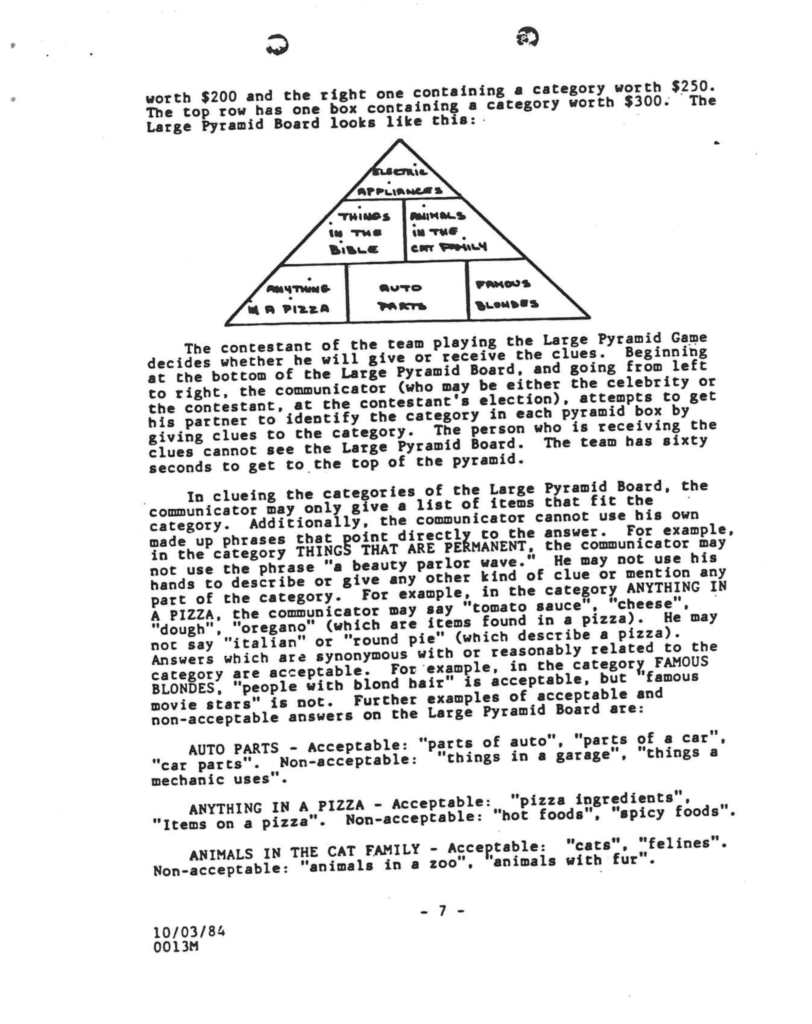
Also, most game shows have more rules written down than you’ll ever hear the host mention on the air. Shows don’t want to bog down its viewers by overexplaining, and time spent explaining rules is time not playing the game, so certain rules are only mentioned if they actually end up being enforced during the show. For example, here’s a rule that the show had in writing for its entire run, but Dick Clark almost never mentioned it on the air:
A further restriction is that the communicator may not describe the item by means of an unrelated rhyme (e.g., describing “table” by saying, “It rhymes with “sable'”‘).
Even if the host never mentions the rules on the air, the important thing is the contestants do know it. Contestants are given a copy of the bible, or a similar document, before taping, and a representative of the show will verbally explain the complete rules before showtime. Hence a disclaimer that you’ve probably noticed at the end of lots of game shows:
Contestants are selected in advance and are advised of the rules of the game.
The show bible sometimes goes beyond the do’s and don’ts of playing. The bible also covers certain potential problems with other elements of the show. For example, each day, the show featured a category called the Mystery 7, which offered a bonus prize. Here’s the show bible explaining a potential issue with offering a certain type of prize, and how they’ll handle it:
Sometimes, the trips offered as prizes on Mystery 7 are available only for a limited time period. In such case, contestants are asked during the selection procedure whether, if they won, they would be able to take the trip during such time period. If they would not be able, then they are not to be selected to participate in the game on which that trip is being offered.
And there’s still more! The bible has everybody prepared for potential mishaps that could happen while a game is in progress. Here’s an excerpt from a section titled “Mechanical Failure”:
A simultaneous stopwatch is kept in the Control Room to be used in the event of a breakdown of the countdown clock (which times the thirty-second rounds on the Small Pyramid Board and the sixty-second rounds on the Large Pyramid Board). If the countdown clock suddenly stops in the middle of a round, the stopwatch is used in in lieu of the countdown clock to determine the end of the round.
At this point, we think you get the idea, but you should know that the 21-page bible for The $25,000 Pyramid also explains which affadavits the celebrities must sign before the taping and why; how the game will be played if the computer that shows answers to the clue-givers breaks down; which employees are responsible for creating the material used in the game; which people present for the taping are to receive printouts of all the categories and correct answers for that day’s taping. The bible is a guideline for everyone involved in the detailed process of making a game show happen. And even when it’s 20 pages, it’s a good way to ensure that everyone is on the same page.
