



BY: Robert King, 2024 Valentine-Cosman Research Fellow
Stop me if you’ve heard this before: What can drive cars, write essays, diagnose diseases, and is bad at jokes? Answer: Artificial Intelligence. (With apologies for the crummy riddle.)
Ever since AI’s astonishing advances in recent years, news of its accomplishments has been accompanied by a sour note: it can’t do humor. A 2023 study gives the statistics. When asked to generate over a thousand “original” jokes, ChatGPT returned the same 25 jokes in some 90 percent of its replies, none of which were original. But what of it? The oft-cited “father” of AI, Alan Turing, once dismissed the issue of computational humor as irrelevant to the question of machine intelligence—about as important as teaching a computer to enjoy strawberries and cream, he believed. Fast forward to the present, though, and the narrative has changed. Today, computational humor is more likely to be considered “AI-complete.” If we could find a computational model for the generation and understanding of humor, then, according to the AI-complete view, we would have solved all problems related to the algorithmic modeling of human intelligence—which is to say that humor is now the ultimate Turing-test challenge, as opposed to something that Turing could ignore.
This transition invites historical analysis. Why has humor come to be one of the sorest of AI’s thumbs? What might the history of computational humor tell us about evolving models of artificial intelligence, as well as our theories of humor? These are the types of questions that inform my current book project, Humor Machines, and which led me to The Strong Museum in the fall of 2024 with the support of a Valentine-Cosman Fellowship.
*
Here’s another one for you: what do you get when you cross the history of play with the early history of computational humor? Answer: word games. Or rather, a specific type of word game. The slot-filler.
Back in the 1990s, long before our current era of machine learning and neural networks, most attempts at computer-generated humor involved familiar joke templates—knock-knock jokes, lightbulb jokes, walks-into-a-bar jokes, etc.—into which the computer would insert semantic variables, fill-in-the-blanks style. A pioneering example here would be Kim Binsted’s Joke Appreciation and Production Engine (JAPE), which was a computer system for generating “What do you call?” riddles. The program would find a noun phrase in its lexicon (say, “serial killer”), replace one word from that phrase with a homophone (thus producing “cereal killer”), and then generate an alternate description for the newly generated phrase (in this case, “a murderer with fiber”). The transformed phrase would go into the punchline slot, the description into the setup line: “What do you call a murderer with fiber? A cereal killer.”
More recently, slot-fillers have been a popular framework for creating witty bots, particularly on Twitter/X (until, that is, Elon Musk began charging for access to the platform’s API, instantly pricing most bot creators out of the market). Examples here are too many to name, but would certainly include Darius Kazemi’s @twoheadlines bot, which would take a headline from an online news source, remove a noun, and substitute a new one taken randomly from another trending headline. (An example from 2018 declared that “John Cena’s efforts to build a Trump Tower in Moscow went on longer than he has previously acknowledged”—where, presumably, “John Cena” has been substituted for the slot left by “President Trump.”) This kind of absurdist randomness was in fact one of the hallmarks of Twitterbot humor in its heyday. Amateur bot creators could even use a web service called Cheap Bots Done Quick (CBDQ) that would craft absurdist tweets by slotting random variables into predefined templates. (At the time of its closing, CBDQ had been used to create a staggering quarter million bots that operated this way.)
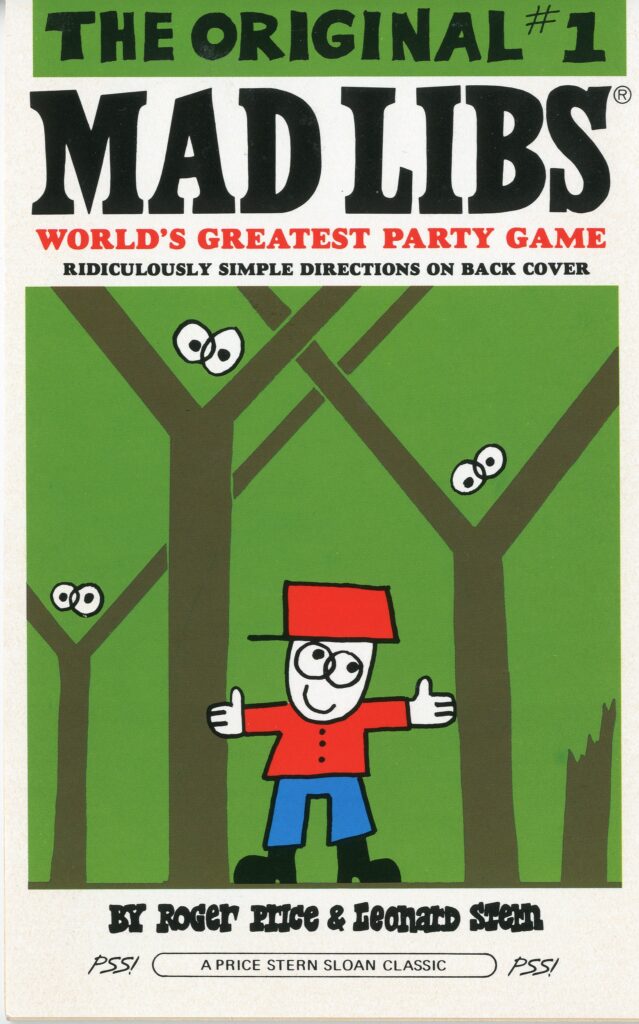
It is difficult not to think here of precursors like Mad Libs, which, popular memory (or at least Wikipedia) tells us, “was invented in 1953 by Leonard Stern and Roger Price.” What popular memory (or Wikipedia) forgets, though, is the long prehistory of these slot-filler games, which is what brought me to The Strong Museum in the first place.
*
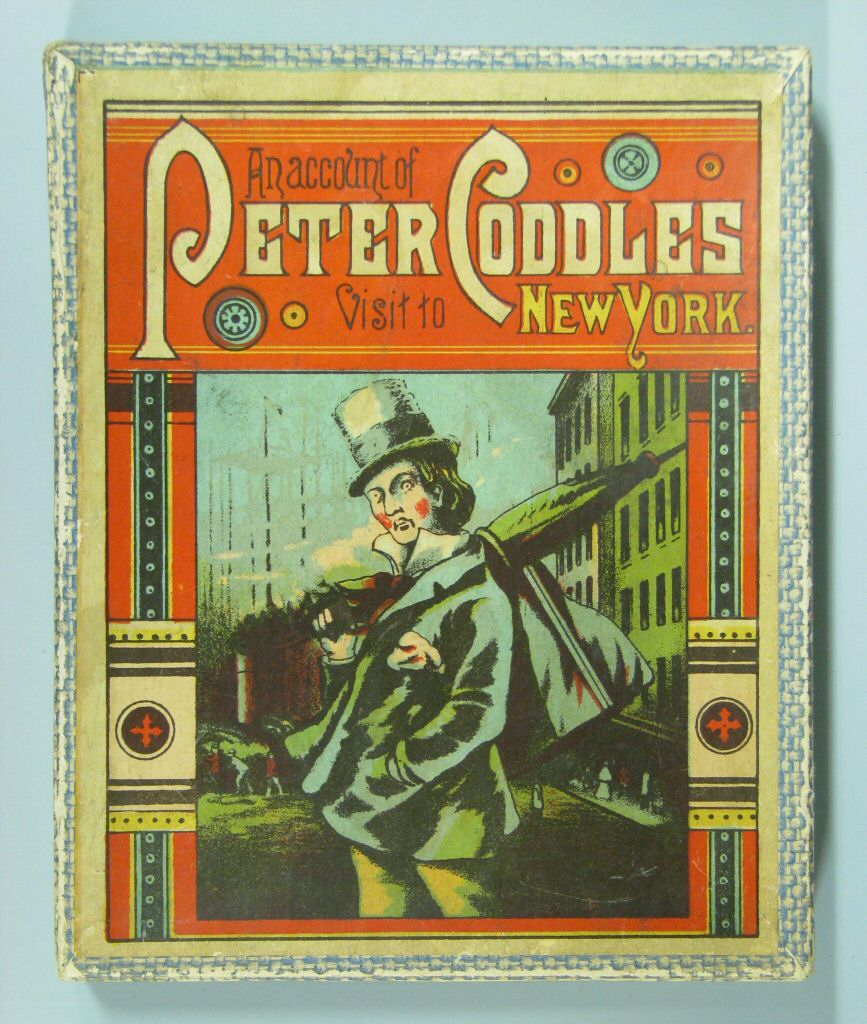
Any slot-filler game consists of two components: a text with slots to be filled, and a pool of words—a lexicon—to fill them. And there are two ways to build the lexicon: you can ask players to contribute words or you have words already prepared on paper slips. Mad Libs is an instance of the former approach, but it was preceded by nearly a century of commercial games that took the latter path. The Ur-example here would be Peter Coddle’s Visit to New York, first published in 1858 by Milton Bradley. But other companies were quick to get in on the act: the museum’s earliest relevant holding is Peter Coddle’s Trip to New York: Three Games in One, released by Gould and Lincoln in 1865. The Strong also holds a number of later versions from Parker Brothers, Selchow & Richter, J. H. Singer, and others (with the preponderance coming in the 1890s), as well as reimplementations like Peter Coddle’s Dinner Party, Peter Coddle’s Trip to Chicago, Uncle Josh’s Trip, Cousin Peter’s Trip to New York, and Brother Jonathan in London.
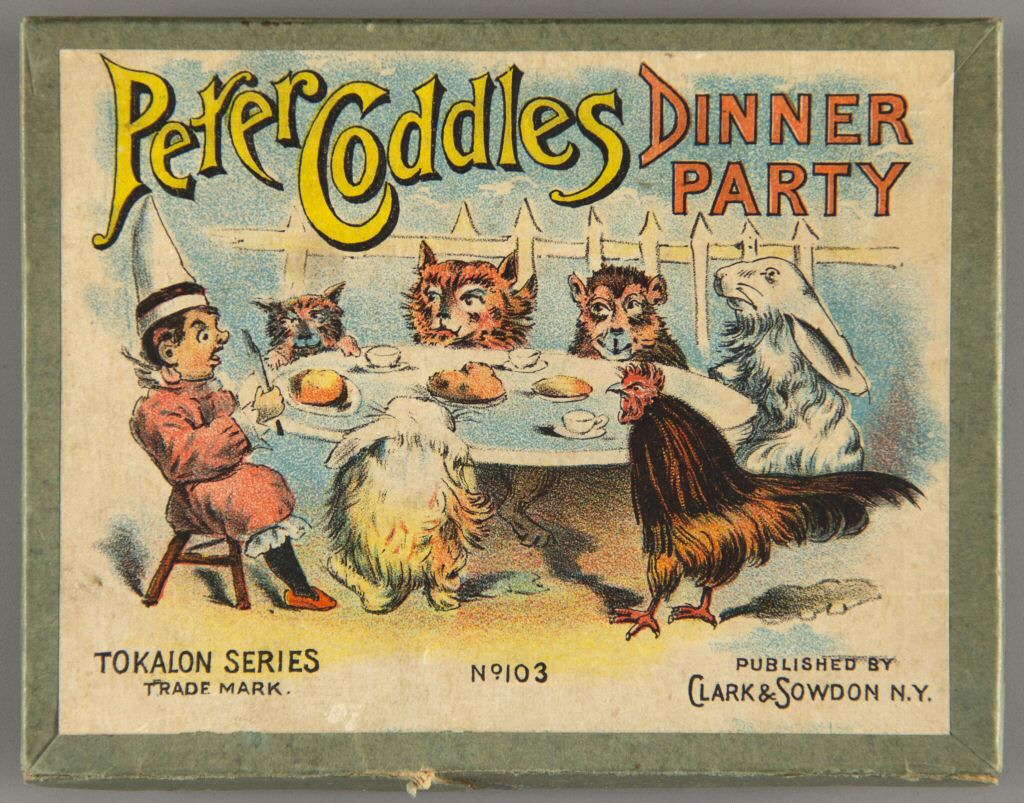
Parker Brothers called these “reading games” and, regardless of publisher, they all adhered to a constant format: a story text with blanks (usually running upwards of five pages) and around a hundred word cards, each to be read out by a player when the game leader reaches a blank in the story. The stories themselves were largely of a piece, too: brief tales of small-town rubes visiting the big city, their comic misadventures accentuated by the surreal juxtapositions the slot-filler phrases create. (An example from Parker Brothers’ Game of Peter Coddle’s Trip to New York: “Peter’s friend secured him an invitation to an old handcart, for which it was necessary for him to have half a pair of scissors. Dressed in this he looked exactly like a dilapidated straw hat and imitated the manners of a smoked herring”—the italicized words here representing possible fill-in phrases from the game.)
*
Not that we should give Peter Coddles too much credit. The Strong Museum’s extensive collection of game books reveals a history of noncommercial parlor games that go back even further. The canonical example this time would be Consequences, in which each player would be tasked to think up a single word to fit specific categories (a man’s name, a woman’s name, a time, a place, what he said, what she said, a consequence, and so on). These would be written onto slips of paper and returned to the game leader, who would compile them into an absurd narrative. The 1857 British game book Parlor Pastimes for the Young reports the following example (again, with the variables in italics):
The handsome and modest Napoleon, met the graceful and accomplished Miss Norton, at Brighton, that fashionable place of resort, on the 10th of November 1890. He said, “Dear lady, my respect for you is unbounded,” and she replied, “Yes, I am very fond of it.” The consequences were, that they were united in matrimony, and the world said, “It is so very silly.”
Hilarious. But, as any historian knows, once you start pushing back, other examples quickly crowd in. If the Victorian era gave us Consequences, then the Elizabethan era already had the game A Thing Done, and Who Did It, as described in Ben Jonson’s play Cynthia’s Revels (1600):
I imagine, a thing done; Hedon thinks who did it; Moria, with what it was done; Anaides, where it was done; Argurion, when it was done; Amorphus, for what cause it was done; you, Philautia, what followed upon the doing of it; and this gentleman, who would have done it better.
*
Ben Jonson, father of the slot-filler game? That seems like a stretch. What we can say for sure is that Mad Libs, so far from being the slot-filler’s origin, instead integrates elements from both trajectories discussed here: its innovation was to combine the pre-written texts of the Peter Coddles-type games with the player-generated lexicon used in Consequences and A Thing Done, and Who Did It.
What we can also be sure of is the appeal that template-and-variable type games have held over the centuries. Such humor might possibly be described as “modern,” in the sense that it could only flourish outside of a deterministic worldview that would have interpreted chance as divine message. But it can in no meaningful way be described as “computational.” Not only has the slot-filler long been a staple of humorous nonsense, but it also represents just one item in computational humor’s repertoire (which would also include synsets, Markov chains, N-grams, etc.). The foregoing is one small step toward an archaeology of those techniques. The giant leap, as it were, would be to transform insights from computational humor’s media precursors into a new model of humor’s form and function.
Which, incidentally, would be what you get when you cross media archaeology with humor theory.
