



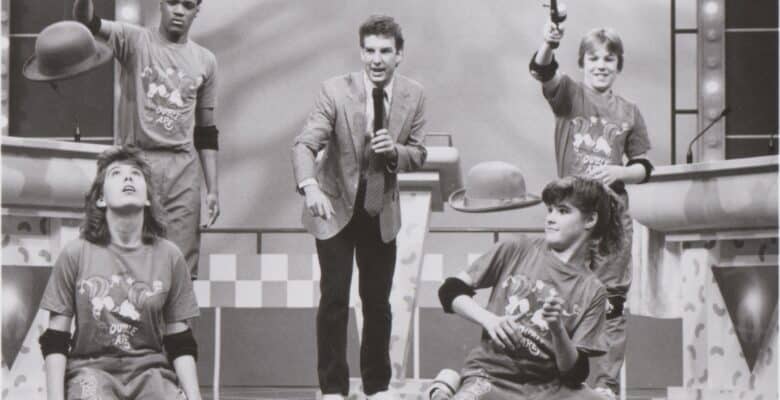
By Adam Nedeff, researcher for the National Archives of Game Show History
“On your mark…get set…GOOOOO!”
On October 6, 1986, Marc Summers uttered those words to kick off Nickelodeon’s Double Dare… and changed the face of television. Nickelodeon had survived a mostly unremarkable seven years on the air, originally launching an educational channel for children. The surprise success of a Canadian show, You Can’t Do That on Television, led to a philosophical shift in the early 1980s and the channel began focusing more on entertainment. Double Dare became an overnight sensation, becoming the highest-rated show on cable television, spawning a Fox prime-time version, a syndicated version on TV stations across the country, a live touring production, and a merchandise line. As a result of Double Dare’s success, Nickelodeon became a key brand for children’s entertainment, a tastemaker and trendsetter.
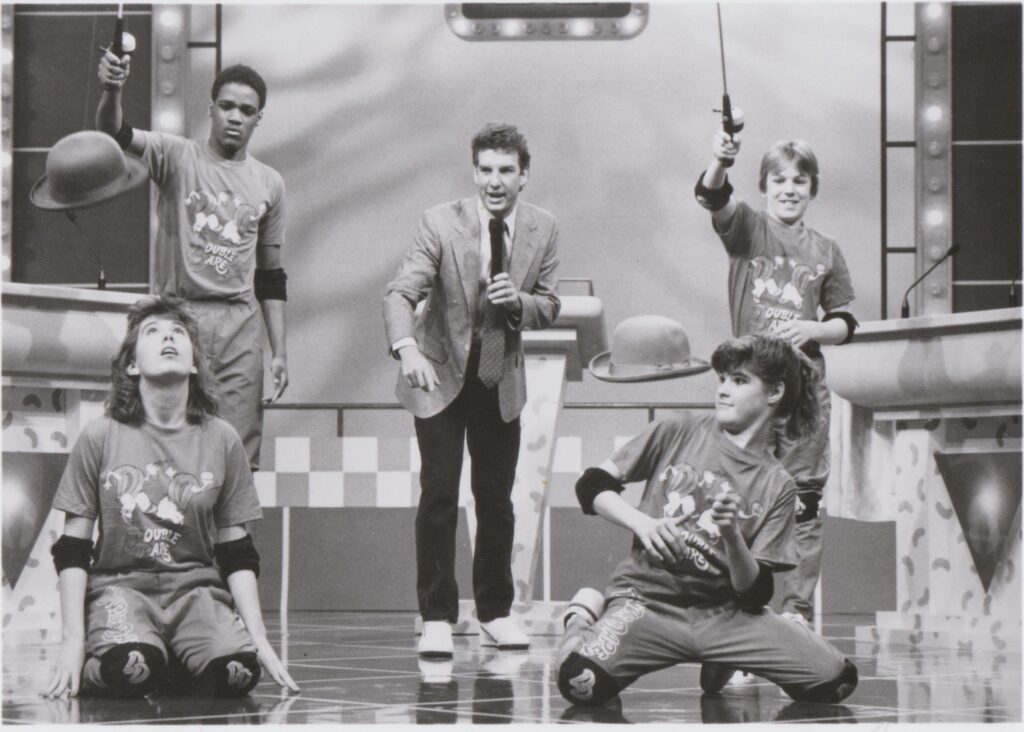
There were so many people involved at different stages of development that it’s hard to zero in on the very start of Double Dare’s development. By one account, it began life as an idea from Nabisco. The company reached out to Nickelodeon looking to make a cookie-themed game show. The idea was rejected, but this got Nickelodeon’s brain trust thinking about what a game show on Nickelodeon might look like; they hadn’t done that yet. Gerry Laybourne, Nickelodeon’s president at the time, organized a huge meeting. Everyone who worked at the channel was invited. From there, Double Dare was developed more or less as a committee project.
Geoffrey Darby, a producer at the channel, making an interesting choice of words, said that it was important that the game have a “jeopardy.” There had to be some sort of risk in the game. This brought up the kids’ game of Truth or Dare, with “Truth” being replaced by trivia questions. The room gradually came up with the idea of a dare leading to something messy.
National Archives of Game Show History co-founder Howard Blumenthal had early meetings with Laybourne and Darby. There were likely multiple meetings with different groups of outside producers and developers. The term “double dare” was conceived at one of these meetings, with Blumenthal recalling that he and several other people blurted out the phrase while workshopping ideas for the game. Blumenthal also collaborated with Michael Yudin and a small group of others in the development process.
The format was still a bit nebulous, but at that stage, it had a combination of questions and “stunts” (later renamed “physical challenges”) as an alternative to questions. It occurred to the staff that children might be self-conscious about not knowing the answers to harder questions. The staff devised the idea of the Physical Challenge, something that contestants could do instead of trying to answer the hard questions. It also satisfied an issue that Geoffrey Darby had with the idea of having the kids do physical stunts. He instantly knew that it would be the more engaging part of the show, and he didn’t want the risk of, say, viewers not watching the first ten minutes of the show because the messy stunts were played in Round 2. The Physical Challenge meant that a viewer never knew when a messy stunt was about to happen. You couldn’t miss a minute of the show.
At some point in these developmental meetings, the board game Mouse Trap was discussed. By one account, Dee LaDuke, the receptionist at Nickelodeon, voiced her fondness for the game, and thought it would be fun to see a human being in a scaled-up version of that board game. Howard Blumenthal remembers it being brought up more as a general vision for the scenic aspects of the show. That was slowly reworked into Double Dare’s Obstacle Course.
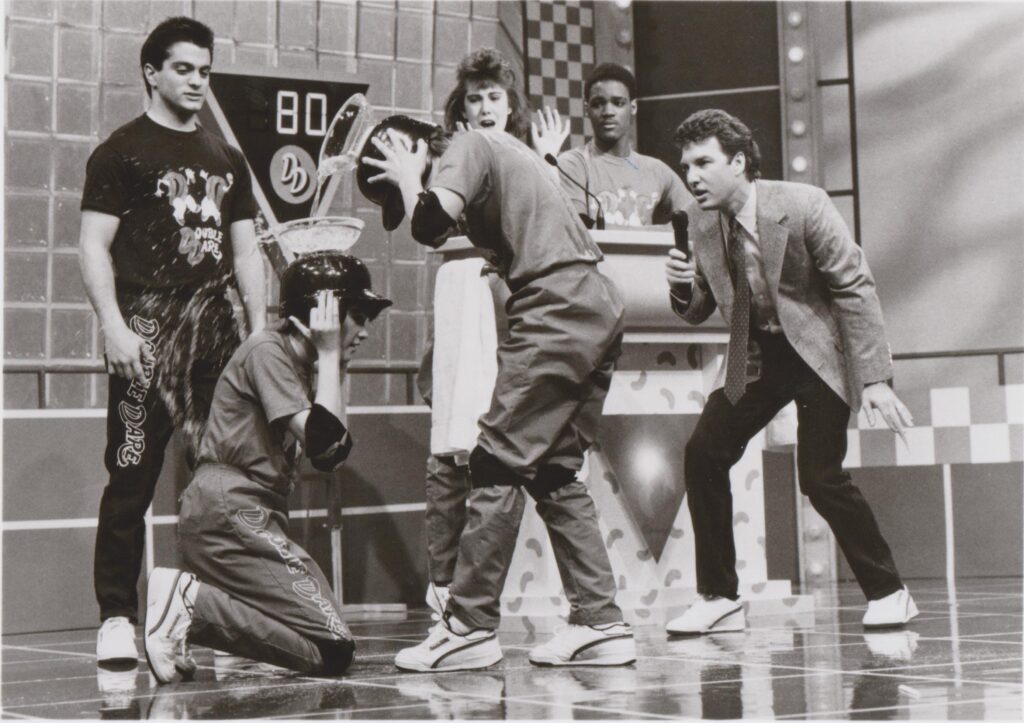
More than 1,200 people auditioned to host the show. Initially, the job was going to go to pie-throwing comic Soupy Sales, but Sales was deemed too old. Dana Carvey was allegedly hired for the job, but got invited to join the cast of Saturday Night Live the same day. Carvey bowed out. The job went to Marc Summers, an aspiring game show host who, in his own words, had “one foot out the door” of show business after a decade of frustrations and a surprisingly successful year as a salmon wholesaler.
Joining him was announcer Harvey (full name John Harvey), a disc jockey in Philadelphia, where the show would tape in the studios of the local PBS station as a cost-cutting measure. Robin Marella and Dave Shikiar would serve as assistants, setting up the equipment for each of the physical challenges.
“I’m going to ask you a question. If you don’t know the answer or think the other team hasn’t got a clue, you can dare them to answer it for double the dollars. But be careful, because they can always double dare you back, and then you either have to answer that question, or take the physical challenge.”
Marc Summers would recite those words on the air over 500 times, with millions of kids having them totally memorized by the time Double Dare’s original run ended in 1993. The show returned twice more, with a run in 2000 and another one spanning two seasons in 2018 and19.
On October 4, Marc Summers, Robin Russo (nee Marella) and Harvey will return to Philadelphia for the 40-Year Double Dare Reunion at City Winery. Attendees will have a chance to take Physical Challenges for fabulous prizes. Throughout the night, Marc Summers & friends will reminisce about the classic series. Tickets for the event are completely sold out, but on October 30, the entire show will be available for pay-per-view streaming on eventive.org

