



When South African bishop Desmond Tutu received the Nobel Peace Prize in 1984 for his anti-apartheid activism, Linda West Olds of Delaware turned to her 10-year-old son Kevin and asked: “Do you know what segregation is?”
He did not.
Perplexed, Olds probed further. Did he know who Ralph Bunche was? What about Andrew Young? Kevin drew blanks. He barely knew much about Martin Luther King Jr. As Olds later recalled, her son responded, “Well, he must be a great man, or we wouldn’t be getting out of school on his birthday.”
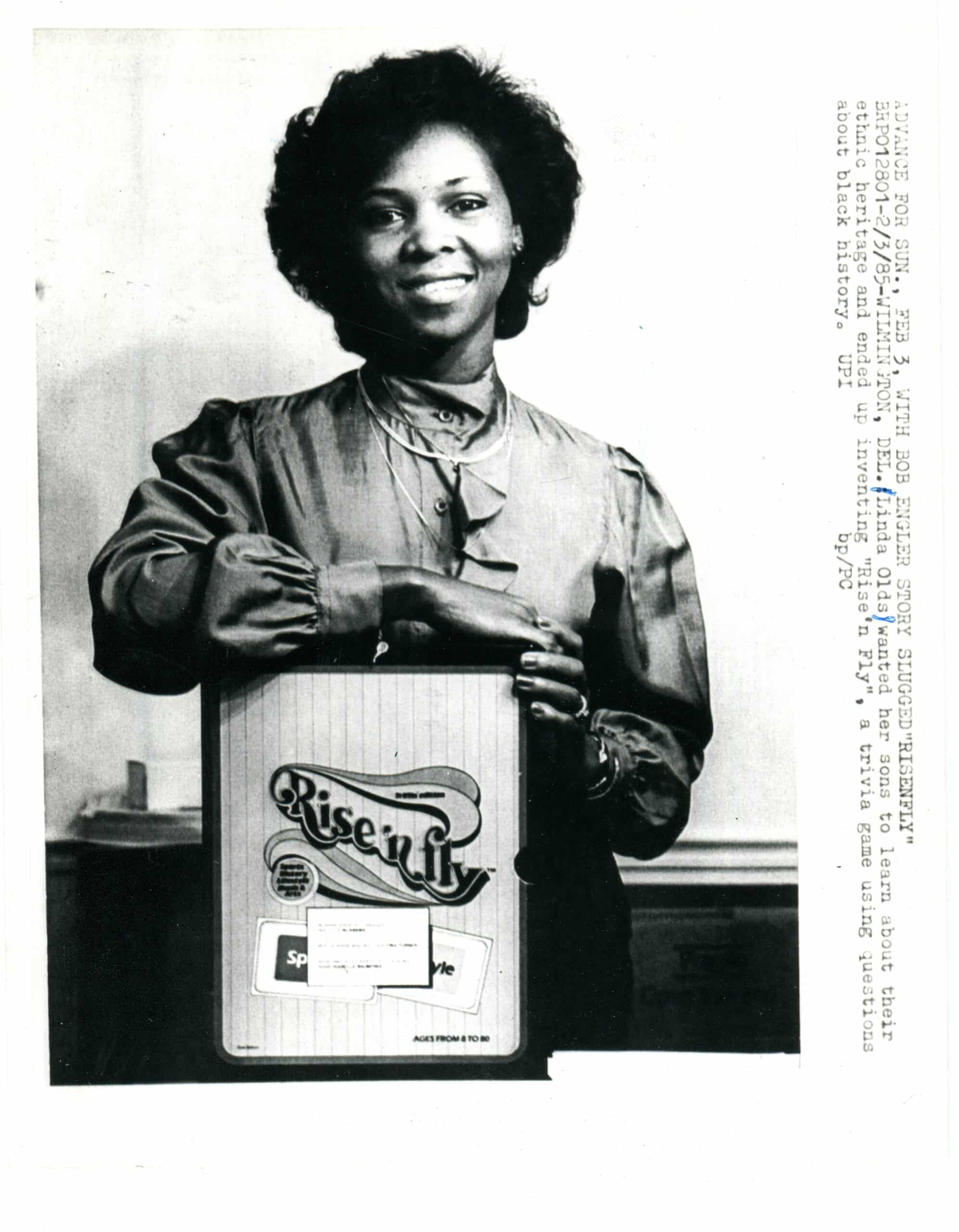
The Strong National Museum of Play, Rochester, New York.
The exchange alarmed her. As she told a group of Black students attending a trivia competition in Tampa, Florida in December 1985, Olds scribbled questions about notable African Americans onto a stack of Uno cards and challenged her two boys and their friends to memorize the answers. What began as a spontaneous educational exercise soon evolved into something larger than she could have imagined.
An Inspiring Pursuit
Olds, a microbiologist by training, had never been particularly passionate about history. In fact, she found the subject dull when she was in school. Yet she told the same group of students that she believed strongly that “my kids ought to know something about Black history.” The idea of turning her homemade trivia cards into a commercial game emerged after friends invited her to join a session of Trivial Pursuit. She told Wilmington’s Morning News in January 1985 that she did not play because trivia consisted of “facts you can live without knowing.” However, she noticed that the wildly popular game contained little information about Black people.
Olds sought a remedy to this gap.
She spent the next two months immersing herself in Black history by compiling 2,400 questions on Black heritage. The process, she later admitted to a reporter from the Times-Union in Rochester, New York, in February 1985, was “incredibly tedious.” But “once I got started, it kind of just mushroomed.” She “knew that other black families would want something like this for their children.”
Libraries and museums became her second home. She took research trips to New York and Washington, DC. Originally a solo effort, Olds enlisted historians in Chicago and New Orleans to help review the material. There was “so much that was left out because you can’t include everything,” she stated in a 2026 interview with The Strong. Early playtests in Los Angeles produced encouraging results in Watts, a predominantly Black neighborhood, and Long Beach, a middle-class white community.
The effort birthed Rise ’N Fly, a Black history trivia game that became a national sensation. Officially launched in late 1984, the game sold 11,000 units within four months. By its third year on the market, sales had approached 30,000 copies across the United States and the Caribbean. Bloomingdale’s, Macy’s and other department stores struggled to keep copies in stock. Coca-Cola purchased 10,000 copies for Black History Month promotions. The success attracted widespread media attention. Time, The Wall Street Journal, Ms. Magazine, Ebony, Black Enterprise featured Olds and her creation. She traveled extensively on speaking engagements, drew interest from educators, and saw Rise ’N Fly incorporated into trivia competitions and classroom activities. In 1985, the Delaware House of Representatives formally recognized Olds’ accomplishments through a House Concurrent Resolution.
Playing to Learn
As Olds explained during a December 1984 appearance on Louisiana Public Broadcasting, Rise ’N Fly combined luck, strategy, and knowledge of Black history. Up to twenty players could participate. Each player received seven cards, with three questions printed on the reverse side. Questions were divided into four color-coded categories: black for history, red for music and the arts, green for sports, and pink for lifestyle and culture. Participants bid on how many questions from their opponents’ cards they believed they could answer correctly. The first player to earn seven points won the game.
The title itself derived from a modified version of the card game Bid Whist. In the game, players “rise” with increasing bids and “fly” when they leave the bidding process.
Featuring the red, black, and green colors associated with Black nationalism, Rise ’N Fly was unmistakably marketed as a Black educational game, but one where all races can play.
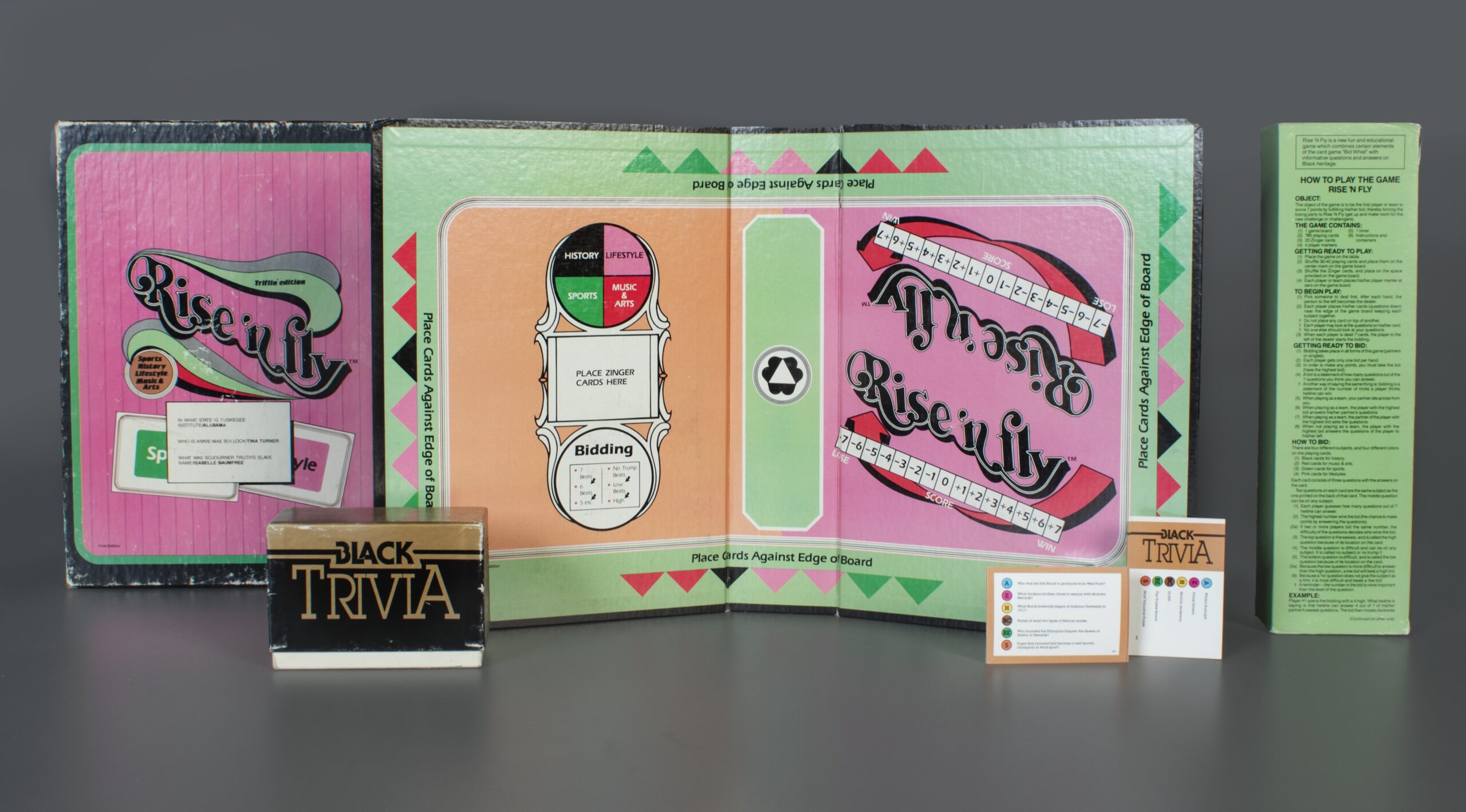
The Strong National Museum of Play, Rochester, New York
The game’s popularity reflected a broader cultural moment in the United States. In the decades following the civil rights movement, Black parents, educators, and entrepreneurs increasingly worried about the lack of Black history being taught and discussed in American schools and society. “In the ‘60s, everyone seemed interested in the civil rights struggle and black history…but in the past 10 or 15 years we’ve been slipping,” Olds lamented to the Times-Union reporter. Although campaigns to challenge Eurocentric curriculum occurred on high school and college campuses in the 1960s, Black history remained marginal in many classrooms. Even well-intentioned teachers often lacked the training or resources to teach it effectively.
In response, a growing number of middle-class Black professionals sought innovative ways to make Black history accessible and engaging. Educational games became one such vehicle. Creators developed products such as In Search of Identity, B.T.’s Black Trivia, Black Quest, and numerous other games designed to teach historical knowledge while entertaining players.
Rising and Flying
The Olds’s educational credentials, professional networks, and financial resources as white-collar professionals provided them with the time and social capital necessary to market the game. Yet her respectable, upper-middle-class image did little to change the assumptions of white retail buyers. Many expressed little enthusiasms for placing a Black-oriented product on their shelves. Retailers often assumed such games would only sell in predominantly Black neighborhoods.
With assistance from her husband Merton, who helped develop the game’s rules and secure financing, Olds persevered. She established the company Olds, Ogden and Johnson, and later became active in the International Black Toy Manufacturers Association, founded in 1987. There she developed friendships with entrepreneurs such as Yvonne Rubie, creator of the Huggie Bean doll, and Yla Eason, founder of Olmec Toys and producer of Sun-Man. Like Olds, they encountered significant obstacles convincing retailers to stock Black-oriented products on their shelves. The association sought to lobby retailers for shelf space and educate aspiring toy and game makers the ins and outs of the industry.
Olds openly acknowledged the difficulties she experienced in marketing her game. Buyers occasionally rejected meetings or failed to appear altogether. Nevertheless, she noted with satisfaction that business remained strong.
A Phenomenal Legacy
The success of Rise ’N Fly eventually inspired Olds to develop versions tailored to other ethnic groups. She successfully launched an Irish Heritage Game with help from her neighbor who was from Ireland and tested it domestically and abroad. Other games remained merely ideas. Later in life, she visited various African countries where people asked whether she could make a game about their country’s history. “Somebody needs to do that, and it would be great. But it’s not for me,” she told The Strong.
Throughout her success, Olds remained committed to community philanthropy. She donated half of the game’s profits to historically Black colleges and universities and other organizations, including the King Center in Atlanta, Georgia. There, in January 1985, she personally presented a donation to Coretta Scott King, who Olds had long known from her days babysitting King’s children in Atlanta.
The phenomenon of Rise ‘N Fly ceased by the late 1980s but Olds’ journey is a storied tale within the long history of Black play and Black representation in commercial products.

