



What are your thoughts about amphibians? Maybe that segment of the animal world hasn’t crossed your mind recently, but I’ve been noticing a surprising number of frogs around The Strong museum’s collection. Frogs have been cropping up in children’s stories for centuries now, from “The Frog Prince,” a German fairy tale collected by the Brothers Grimm and published in 1812 to more recent books, such as Arnold Lobel’s story Frog and Toad Are Friends (1970), which offers readers a couple of amphibian pals. So many frogs!
What makes frogs appealing to us? They may not look cuddly like pandas or elegant like flamingos, but they have one superpower—they jump. In his 1865 short story “The Celebrated Jumping Frog of Calaveras County,” Mark Twain brought fame to a frog and, in return, the frog brought fame to Twain when the story became his first national success as an author. Repeatedly across the decades, jumping frogs play a featured role in toys.

Going back to about 1895, this mechanical bank features two frogs whose mildly amusing antics encouraged children to save their pennies. I’ll admit, in our age of Apple Pay, Venmo, and tap-and-go credit cards, it’s a bit of a challenge to envision the importance of saving coins, but banks were once popular gifts for children. Where piggy banks were much less engaging—just drop the coin in a slot, big whoop—mechanical banks added a bit of a surprise to stashing your dough inside. This particular example consists of two cast iron frogs on a base molded to look like grass. The larger frog sits alert on its four legs, while the smaller frog lies on its back with front feet that hold a flat coin plate. When a coin is placed in position and a lever behind the large frog is pushed down, the small frog’s left leg kicks up and back, knocking the coin into the big frog’s opening mouth. Lord knows, no one wants to encourage children to literally consume their savings, but cultivating the skill of patiently amassing coins for the future is a positive message to convey to younger generations.

Other frog toys were created primarily for fun. Before Fisher-Price gained its reputation as the home of the Little People toys, it was known for its sturdy wooden pull toys. Introduced for Easter 1954, the Jolly Jumper, as this frog was branded, has acetate feet that flip around the rear wheels and raise the body up and down, all while the frog’s googly eyes roll back and forth. With an internal crank-driven clicker, the Jolly Jumper might help inspire a toddler learning to walk to take a few more steps and keep practicing that new skill.

Speaking of skills, the Hug & Learn Little Leap by LeapFrog Enterprises represents a mixture of fun and learning. Back in 1998 when this product made its debut, it offered relatively advanced electronic technology for a toy. Printed on the front of Leap’s yellow shirt are the letters of the alphabet that kids can push to hear the letter’s name and sound. They can also push his fingers to learn counting, play a “find the letter” game, and other educational activities. The advertising campaign for Little Leap explained that “the most challenging part of a learning toy is getting your kids to play with it. Which is why LeapFrog created Little Leap with giggles, snickers, and silly willies in mind.” Ideally, all those interactions would help your child “leapfrog” academically over their classmates.

Or maybe one frog isn’t enough for you. How about an entire pondful? Originally produced in 1922, the LaVelle Frog Pond game consists of 8 metal frogs, a board depicting frogs on lily pads, and two poles with lines and hooks. Essentially, this is a frog-ified version of the classic kids’ game of Fish Pond. Some historians credit New York game maker Clark & Sowdon with inventing Fish Pond or Fishing, as it’s also called. Knockoffs and variants have proliferated over the past century. Whoever invented the game, many makers produced versions through the years and modern examples are still made today. Instead of printed cardboard fish, the LaVelle Frog Pond uses green painted metal frogs that are “hooked” through holes where their eyes are located. Sounds a little gruesome but, just remember, they’re not real frogs.
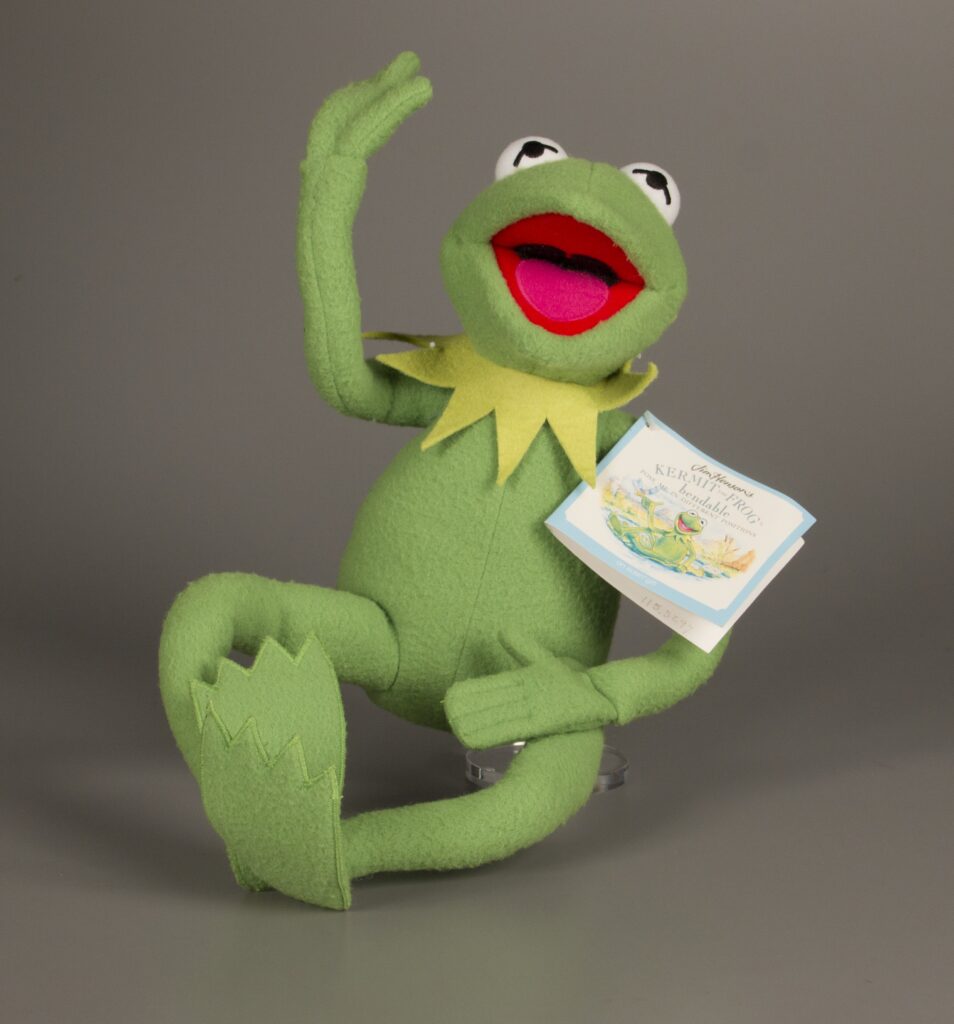
Finally, no discussion of frogs in The Strong’s collection would be complete without a nod to that luminary of the frog world—Kermit. From a modest start in 1955 on a local Washington, DC television show, Kermit began his ascent to stardom when he played a role in the initial cast of Sesame Street in 1969. Broader fame blossomed between 1976 and 1981 with The Muppet Show, where Kermit’s romance with Miss Piggy also flowered. Movies followed and Kermit’s image graced countless products, from toys, games, and stuffed animals to housewares, clothing, and holiday decorations. It may not be easy being green, but that didn’t stop Kermit from worldwide popularity. The museum currently owns almost 300 examples of Kermit’s scope and reach.
So if life has you feeling swamped with challenges, you might want to enlist a little frog friendship to help you make it through the day.

