





Inducted: 2026
EA Sports FIFA International Soccer was not the first sports simulation video game—nor even the first one about soccer—but it became the most popular sports game franchise of all time, with sales continually bolstered by annual releases from publisher EA. Given soccer’s worldwide popularity, EA Sports FIFA International Soccer had a larger global imprint than other sports titles such as Madden, with approximately 325 million games in the EA Sports FIFA series sold by 2021.
FIFA is the global game for the global sport. While in the United States, John Madden Football (based on the American version of football) dominates sports titles, around the world the EA Sports FIFA franchise (based on what most of the world calls “football” and Americans term “soccer”) became the preeminent console game for sports enthusiasts.
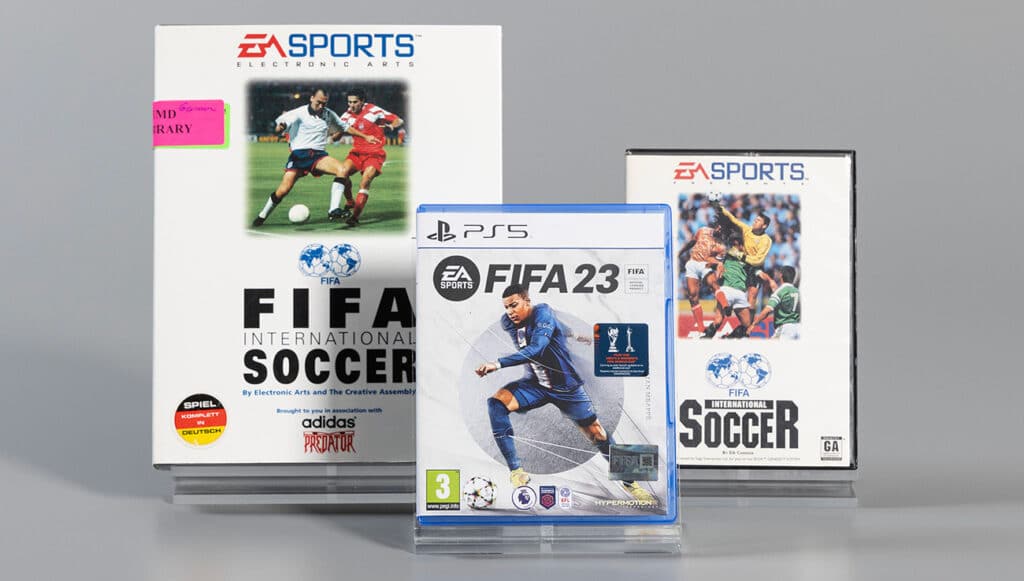
Earlier soccer video games such as Sensible Soccer and Kick Off already offered top-down views of soccer matches, but when EA Sports FIFA International Soccer came out in 1993 for the SEGA Genesis/Mega Drive, it offered an isometric view that charmed fans with its resemblance to televised coverage. True to EA’s approach with other sports titles, the company went to the Fédération Internationale de Football Association (FIFA), soccer’s governing body, and secured a licensing agreement. As it turned out, licensing in soccer proved much less hierarchical than in American sports leagues, so the company eventually had to secure many more agreements with individual leagues and teams to use uniforms, stadiums, and players’ names. This didn’t happen in time for the first edition of the game, but it prompted leagues to become more coordinated about these issues—thus the video game furthered the professionalization of real-life sports leagues. And the relationships helped ensure that EA had rights to many of the most important teams and players in the world.
Developed first at EA Canada and by EA’s offices in Great Britain, EA Sports FIFA International Soccer became one of the first games to feature such close trans-Atlantic development practices. There was thought to call the game “FIFA International Soccer” in Europe and “Team USA Soccer” in North America, but the development team pushed hard for it to be a truly international game. In the end, it featured the same title all around the world, a policy that continued throughout its run.
The game was an instant success. Despite launching in December of 1993, it became the best-selling game of that year in Europe, selling more than 500,000 copies. Over the years, it continued to rack up millions in sales, generating a high percentage of EA’s net profits. As with other sports titles, EA pursued a policy of systematic, incremental upgrades of the game each year to bring greater realism to the graphics, play, and strategy. Some titles in the series such as FIFA: Road to World Cup 98 and FIFA 08 represented major leaps in quality or technical capabilities, while others offered more measured improvements, but the game remained popular because fans knew they could count on more realistic game play every time they purchased a new title. Other games and series like Pro Evolution Soccer have vied for fan affection, but in the end no series title kept up with EA’s evergreen sports franchise, and many of EA Sports FIFA’s features have been incorporated into EA’s new Football game series, ‘EA SPORTS FC’, which continues today!
Did You Know?
FIFA International Soccer was developed by EA’s team in Vancouver, Canada.
Related Content
American Journal of Play Volume 15, Number 2
Advertising Real-World Products in Video Games

