





Inducted: 2026
Dragon Quest, released in 1986 for the Nintendo Famicom, grew out of a collaboration between scenario writer Yuji Horii, manga artist Akira Toriyama, and composer Koichi Sugiyama. Sugiyama was a popular composer, known for his past work on earlier Enix games, who wrung memorable music out of the Famicom’s limited audio capabilities. Sugiyama’s approach to the creation of game music was revolutionary; he was one of the first composers to consider game music as a serious form of compositional art and the first to use a live orchestra to record his compositions for video games, establishing beautiful music as a fundamental feature of Japanese Role-Playing Games (JRPGs) such as the Final Fantasy and Persona series and the recent Game of the Year winner Clair Obscur: Expedition 33.
Dragon Quest’s art stood out as well, but equally important was the narrative structure that writer Yuji Horii designed. A successful scenario writer who had already written what is often cited as the first visual novel, The Portopia Serial Murder Case, Horii figured out how to translate the complicated demands of Western computer games to the more limited input controls of consoles by replacing complex sequences of keyboard inputs with a simplified system of multi-layered, windowed menus. In so doing, he was able to integrate Western “Dungeons & Dragons” elements of player choice and consequence with a tradition of Japanese character development that included non-linear, recursive storytelling such as in his novel. The combination of these elements became the model for the Japanese RPG.
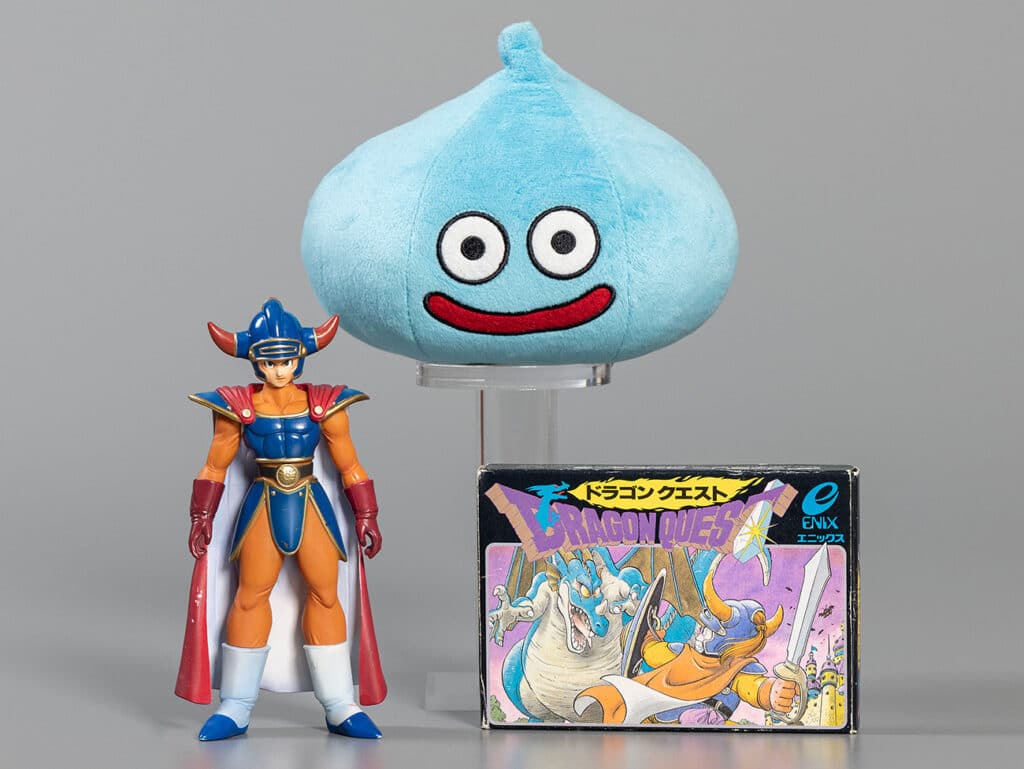
The game’s story also stood out, for Dragon Quest was among the first console games to integrate gameplay into the development of the narrative. Player choice matters in how the story turns out, opening up new paths in the branching narrative. For example, during the final encounter with the game’s main antagonist, the Dragonlord, he offers to give you half the world in exchange for the abandonment of your quest. If you accept the offer, the screen goes red and black, signifying that your greed has consequences. This thoughtful approach would inspire later games such as Earthbound and Chrono Trigger to similarly build ethical and philosophical dilemmas and choices into the very heart of the game.
The game did so well that sequels followed. Their popularity was so great that Enix shifted the release day from a Thursday (standard for Nintendo games) to Saturday, supposedly so kids wouldn’t skip school to get the game. While Dragon Quest’s popularity has always been greater in Japan than abroad, the anecdote illustrates the grip that Dragon Quest had on its Japanese audience. Not even gaming giants like Mario or Sonic prompted social policy shifts like Dragon Quest managed to do.
Horii, Toriyama, Sugiyama, and the rest of the team at Enix concocted Dragon Quest at just the right time. Gamers longed for role-playing games that were fun and accessible, while still maintaining richness and complexity in storytelling, art, and music. Dragon Quest took nods from Western RPG greats like Ultima and Wizardry to inspire a subgenre that put high stock in storytelling, soundtracks, and imaginative imagery. It would be difficult to imagine the modern RPG without Dragon Quest.
Did you know?
Creator Yuji Horii’s first game was a tennis game he submitted to a contest hosted by game publisher Enix.
Related Content
Wizardry, Dragon Quest, and the Japanese Role-Playing Video Game
Video Games Rock Classical Music

