





Inducted: 2026
Angry Birds was the breakout mobile game hit that convinced millions of people worldwide to pay for a game they could download onto their smartphones. More than two billion downloads later, hundreds of millions of people have spent tens of billions of hours flinging brightly colored birds at buildings built by egg-thieving pigs.
At its core, Angry Birds is delightfully simple. Hurl a bird from a slingshot to knock down the pigs’ precariously balanced structures. A quick video intro sets the story, then users can start playing; no lengthy tutorial is necessary. Instead, players acquire skills as they advance through the levels. As with most good games, success proves more difficult than it looks, and players have spent billions of hours trying to master the increasing levels of difficulty that the game provides. Bright colors, whimsical characters, and catchy music contribute to a game that is fun to play for a minute or for hours on end.
It takes more than just good game play to make a hit title, however. Finnish game maker Rovio created an app sensation by designing a game that meshed well with the abilities and constraints of mobile phones and by figuring out how to get the game into consumers’ hands. Rovio had made other games for a variety of different phone systems, but it was only after the release of the iPhone in 2007 that a robust framework for distributing games emerged and Angry Birds, Rovio’s 52nd game, was able to take flight in this digital ecosystem.
Rovio’s management team skillfully positioned and marketed the game. They designed it for the widest possible audience and made sure it was playable either in short bursts or for extended sessions. By concentrating first on smaller national markets in Europe, they built attention and a market for the game. Then they created a free Angry Birds Lite version for the larger English-language markets and signaled their awareness of the new power of social media by creating the second-ever YouTube trailer for an iPhone game. These efforts helped the game rapidly climb the charts of the app store. When Apple announced its list of all-time most-downloaded apps in 2013, Angry Birds topped the charts as the most downloaded paid app of all time with three Angry Birds sequels also in the top 25. By some estimates, Angry Birds has been downloaded more than two billion times.
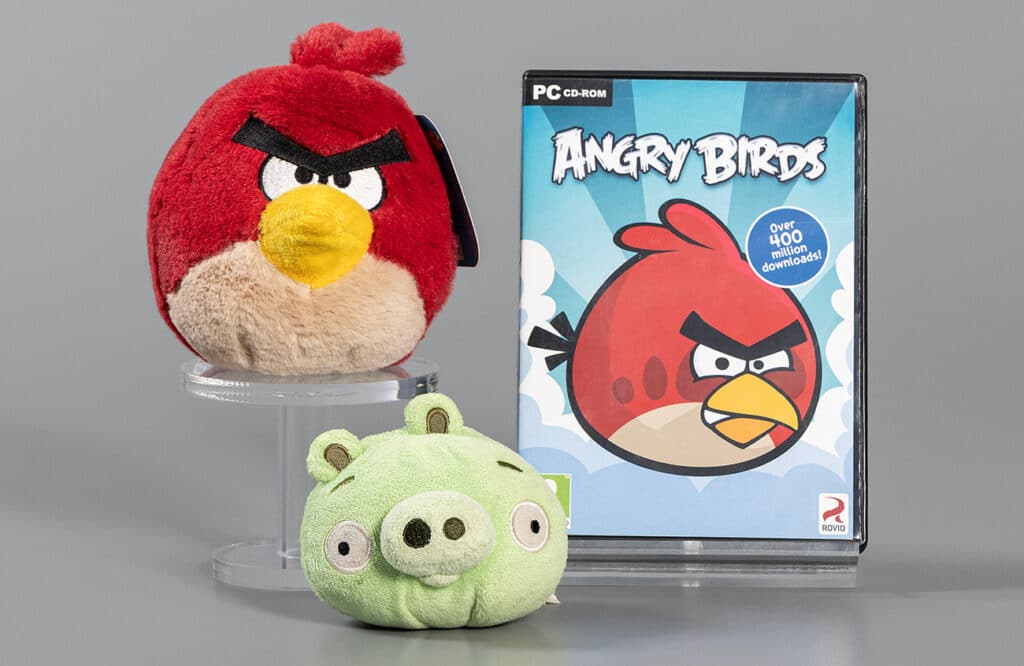
Just as Microsoft’s version of solitaire for Windows 3.0 had taught new computer owners how to use a mouse, Angry Birds made new smartphone users more comfortable swiping, tapping, and playing with their phones. And the game spilled off the screen. Rovio moved quickly into merchandising and transmedia, producing Angry Birds-themed stuffed animals, board games, clothes, and Angry Birds Rio, a game linked with the major motion picture Rio. In 2016, an Angry Birds movie tried to replicate the appeal of other toy tie-ins such as The LEGO Movie, though it didn’t have the same success, and box-office sales diminished for a 2019 sequel.
As the game that helped launch not only billions of birds but the entire mobile gaming revolution, Angry Birds shattered records and helped transform people’s relationships with the palm-sized communication and gaming devices they carry in pockets and purses.
Did You Know?
The pigs were colored green to complement the red color of the birds.
Related Content
Video Games and the Cute Factor
A Short History of Mobile Games

