



By Adam Nedeff, researcher for the National Archives of Game Show History
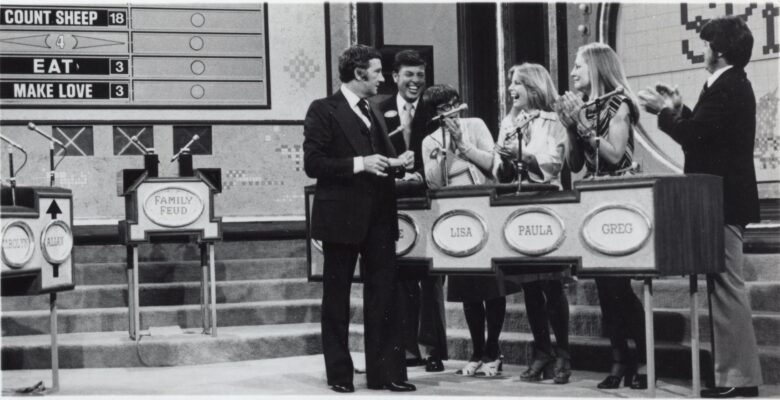
Fifty years ago this month, in July 1976, one of the most successful game shows in America made its debut. Mark Goodson-Bill Todman Productions, the ABC television network, and host Richard Dawson all declared, “Let’s play the Feud!”
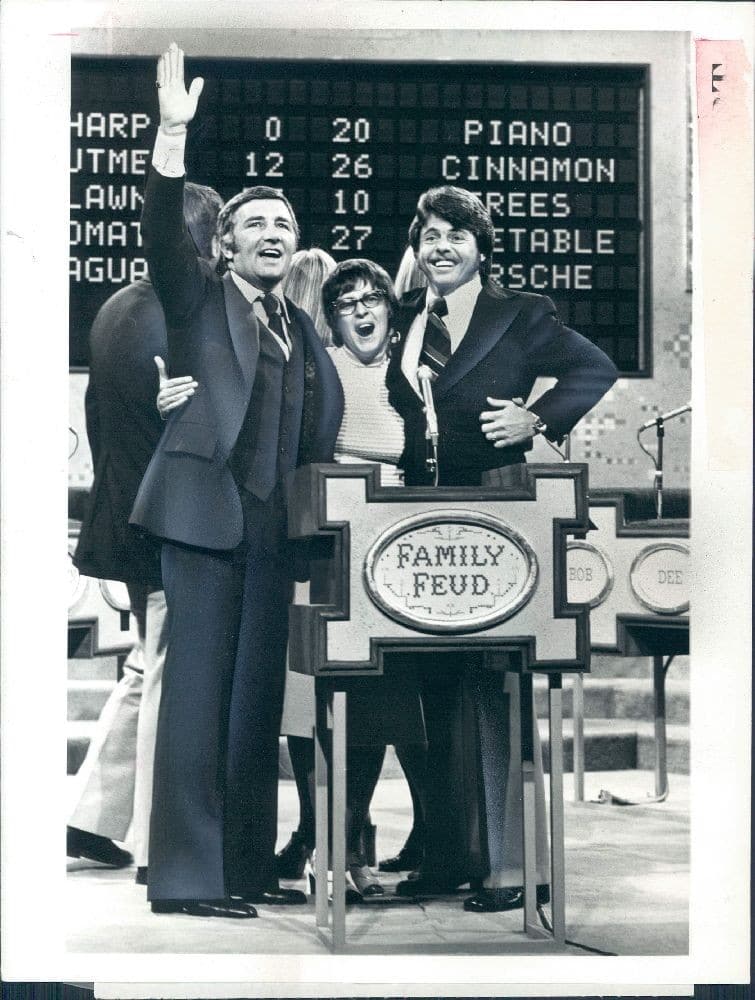
Family Feud came to life thanks to the success of another game show. Goodson-Todman’s Match Game on CBS was the most popular show on daytime TV in the mid-1970s. One round of the game, Audience Match, had a contestant trying to match one of the three most popular answers in a survey taken by a previous studio audience.
Around the Goodson-Todman offices, staffers began toying with the idea of making Audience Match its own show. By one account, the earliest idea came from Ted Cooper, a set designer once referred to as “Mark Goodson’s secret weapon.” Not only did he design beautiful sets, but he had an affinity for electronic gadgets and machinery that he often incorporated into his designs. For the classic game Password, he had designed a massive desk for the contestants that concealed a system of pneumatic tubes that would cause passwords to pop up to the surface for the show’s Lightning Round.
Cooper had been thumbing through a magazine and found an ad from a Canadian electronics company, Ferranti-Packard, which had developed a “flip-disc board,” a display of magnetic black and yellow discs that would flip back and forth to form letters, numbers, and symbols on a large sign, with the entire display controlled by a computer. In the 1970s, Match Game’s answers for Audience Match had to be stenciled and painted onto massive sheets of poster board by the CBS graphics department, well in advance of taping. Another game show, The Newlywed Game, had to quickly scribble contestants’ answers with Magic Markers onto small cue cards. Ted Cooper was enamored with Ferranti-Packard’s flip disc sign and wanted a new toy to play with. He thought it would look cool if contestants had to come up with spontaneous answers to questions, and the answers were instantly displayed on a giant electronic readout.
As the ideas started coming together, boss Mark Goodson was worried that survey answers might prove too unpredictable to support an entire 30-minute game. He turned into a believer when a few sample surveys were collected and he was shown that the rankings of the answers were surprisingly consistent among multiple groups of 100 people. Also, his staff was noticeably having fun trying to match the answers on those surveys.
His staff originally developed a format that they named On a Roll, and then Fast Company, in which two contestants competed against each other. But the staff noticed a problem: contestants asked to match the top six or seven answers in a survey could come up with one or two answers off the top of their head but then run out of ideas. The game could be a little dull as a result. The game needed more players; teammates instead of one-on-one contestants. When the staff tried playing with teammates who were members of the same family, they hit the jackpot. They wanted to win money, but they wanted their family to win money, too. The game became Family Feud.
The next step was finding a host. Initially, Goodson-Todman went down the usual list of names of game show hosts in the 1970s. Geoff Edwards (Jackpot) was offered the job first, but turned it down. He later said he had been given a bad description of the game. What he was told sounded like The Neighbors, an ABC game that had recently bombed, and Geoff didn’t want to host a game that he expected to fail. It was actually nothing like The Neighbors, but Geoff didn’t know that until it was too late. Veteran host Jack Narz (Seven Keys) was considered too.
But then Richard Dawson unexpectedly jumped to the top of the list. Richard Dawson was a regular panelist on Match Game, so even though he wasn’t really known as a game show host, the notion of Dawson hosting a Match Game spinoff made sense. Besides that, during a Match Game contract renegotiation, he had received a cushy clause that allowed him the chance to host a game show for Goodson-Todman. Dawson had one ace in the hole: Michael Brockman, the head of ABC daytime, had seen Dawson host an unaired, unsold pilot in 1975, titled The Numbers Game. Brockman rejected the show itself, but made a mental note because he liked Dawson’s performance. Brockman liked the show that was becoming Family Feud, and he liked Dawson. The combination worked. Family Feud would be hosted by Richard Dawson.
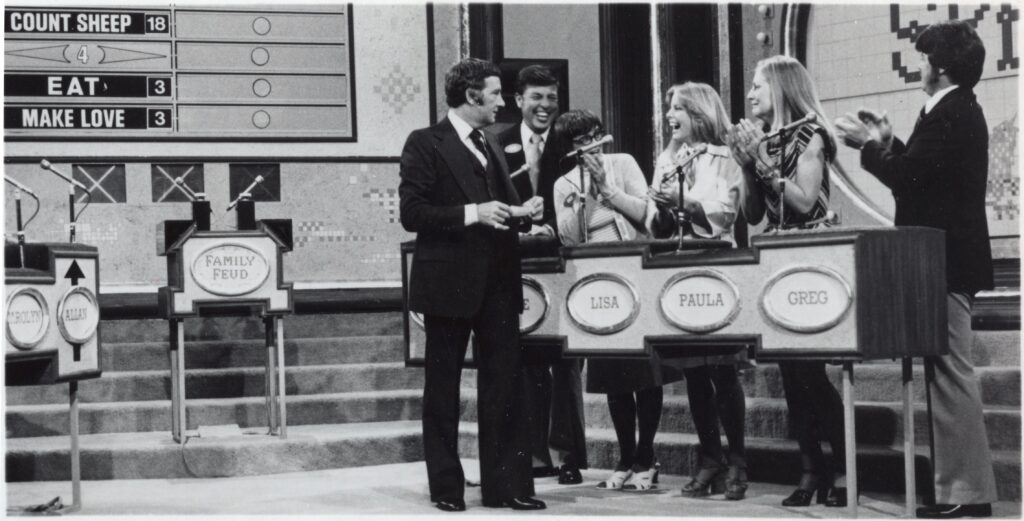
A few finishing touches were made in the sound department. The theme music for the show was an efficient bit of recycling by Goodson-Todman. They used a tune that had composed to accompany the reveal of “A NEW CAR!” on The Price is Right, with fiddles and banjos added to the track to evoke the thought of the Hatfields & McCoys, the most notorious feuding families of all time.
The staff settled on a boxing bell for revealing the answers in the survey, apparently to reinforce the idea that the game was a “fight” between the families. There was one last detail that was giving everyone a surprising amount of trouble. Each survey started with a “Face-Off,” in which two opponents rang in to answer, and Goodson didn’t like any of the sound effects that were suggested.
Goodson went to his dentist’s office for an appointment. While in the chair, the dentist’s telephone rang, and Goodson blurted out “That’s the sound!” He called ABC and asked the network to dispatch an audio technician to the dentist’s office. The technician made a recording of the telephone ringing, and that became the sound of the Face-Off button for Family Feud.
Family Feud premiered on July 12, 1976, and was an overnight success. Home games, a nighttime version, and prime-time network specials all followed. Dawson became a popular guest host during Johnny Carson’s nights off and briefly was considered a front runner to become the new host of The Tonight Show if Johnny retired.
Feud hasn’t been on the air continuously since, but life without Family Feud has been fairly brief. After it was cancelled in 1985, executive producer Howard Felsher remarked that the show was only “on hiatus” and by 1987, the company was shooting a pilot for a revival hosted by comedian Ray Combs. Family Feud with Ray Combs ran from 1988 through 1994, when Dawson returned for one more year. After 1995, Feud was gone, although by that point, Game Show Network had launched and Family Feud reruns filled the void until new episodes started back up in 1999. The new version was initially hosted by Louie Anderson, then Richard Karn, then John O’Hurley, and Steve Harvey, who has held the job ever since.
DO YOU REMEMBER…THESE OTHER GAME SHOWS FROM THE SUMMER OF 1976?
The Hollywood Squares (NBC) – Peter Marshall hosted the game, then in its 11th year, in which contestants earned squares on a supersized tic-tac-toe board by guessing if the stars were giving the correct answers to trivia questions.
Celebrity Sweepstakes (NBC) – Jim McKrell hosted this twist on The Hollywood Squares in which contestants placed bets on the celebrity panelists who had to answer trivia questions, with an audience vote setting the odds for each star.
Break the Bank (ABC) – Tom Kennedy hosted this twist on The Hollywood Squares in which the stars sat around a game board somewhat similar to Battleship, with the contestants trying to capture the hidden money bags behind the spaces.

