




By Adam Nedeff, researcher for the National Archives of Game Show History
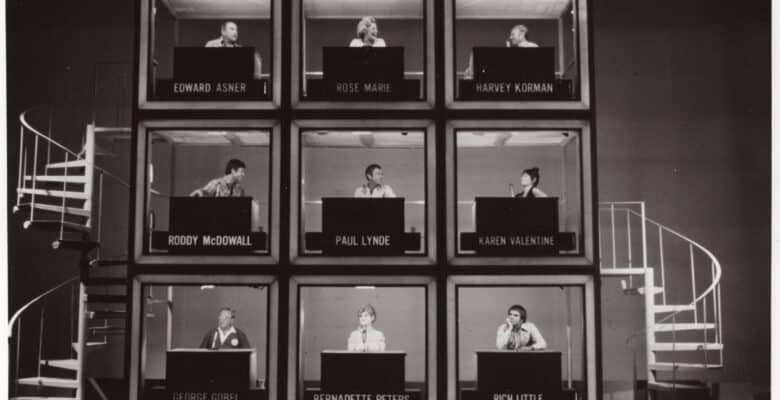
60 years ago, this month—October 17, 1966, to be precise—game show fans first laid eyes upon the largest tic-tac-toe grid ever constructed, an 18’ by 18’ arrangement of boxes and lights from which some of the funniest gags in game show history would emit. The Hollywood Squares with Peter Marshall debuted on NBC.
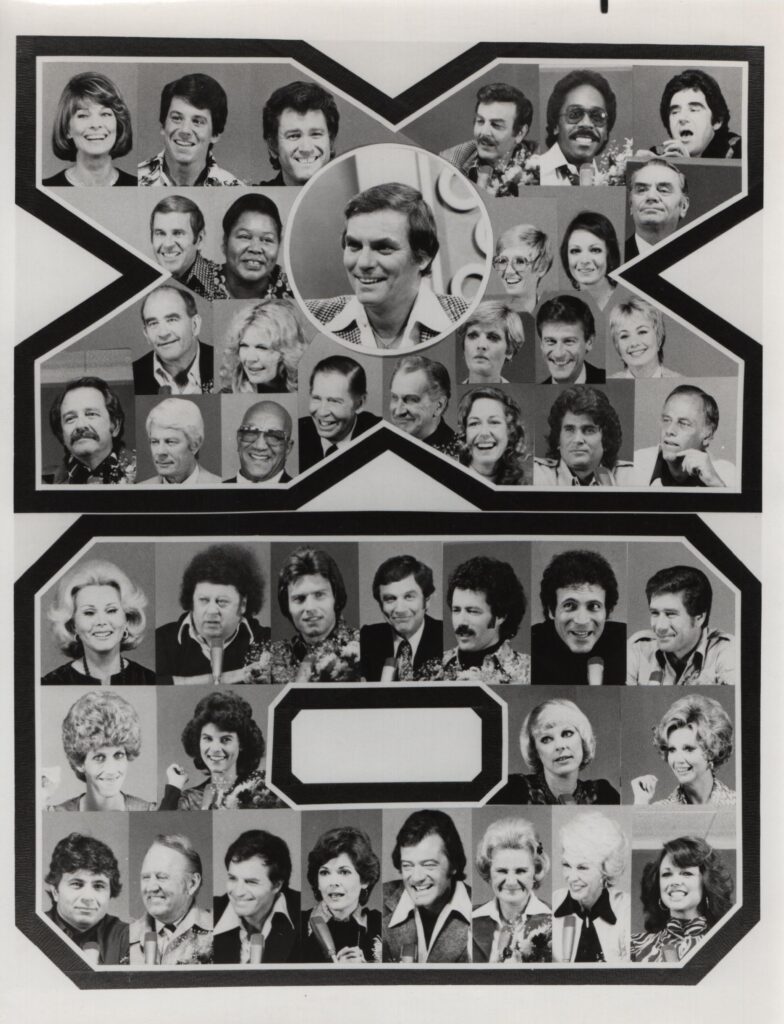
Creators Merrill Heatter and Bob Quigley had been dabbling with variations on an idea in recent years; they wanted a game show that made use of a massive panel of guests. Conventional game shows like What’s My Line? and To Tell the Truth made use of four celebrities on the panel and occasional guest stars. Heatter and Quigley, on the other hand, had devised The Celebrity Game, in which contestants had to guess how nine celebrities had answered personal questions. An even more ambitious game, People Will Talk, had included a panel of 15.
These were the predecessors to Heatter and Quigley’s biggest success. While brainstorming ideas one day, Heatter drew a tic-tac-toe grid and filled it with names of celebrities. The business partners immediately knew that they had something. CBS agreed to shoot a series of pilots but eventually said “no thanks.” NBC put it on the daytime schedule and knew almost immediately that they had a hit on their hands.
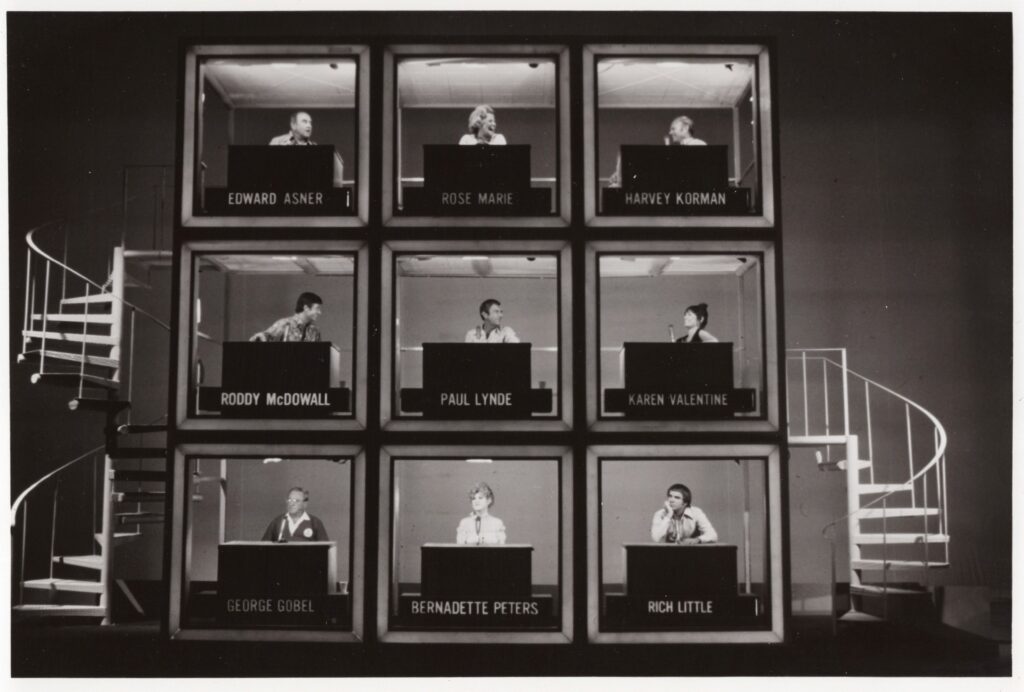
“The object for the players is to get three stars in a row, either across, up and down, or diagonally. It’s up for the players to figure out if the stars are giving them the correct answers or just making them up. That’s how they get the square. Every game is worth $200, and we play a best two-out-of-three match.” – Host Peter Marshall’s famous daily explanation of the rules
It wasn’t that difficult a game to grasp. It was a children’s game, played by adult contestants. There were celebrities. There were trivia questions. Game shows had seen plenty of both. But the “secret sauce” of Hollywood Squares was the way that the stars answered those questions. The show called them zingers.
PETER MARSHALL: Poor Richard’s Almanac says that you should dress to please others, but you should do something else to please yourself. What?
PAUL LYNDE: Undress others.
PETER MARSHALL: At the theater, a woman complains to the usher about your propinquity. What doesn’t she like about you?
MARTY ALLEN: I sat on her Milk Duds.
PETER MARSHALL: According to The Los Angeles Times, is the popularity of belly dancing going up or going down?
MICHAEL LANDON: Both.
The show’s little secret was that the stars weren’t that clever on their own. The Hollywood Squares writers were penning the gag lines for them. Even Paul Lynde, the show’s iconic “center square,” lamented that people assumed that he was a great ad-libber when the truth was he was terrible at improvising and he replied heavily on scripts. But even if viewers realized the lines were scripted (the show eventually started putting a disclaimer at the end of each episode admitting such), they sure didn’t seem to care. Squares was a hit that endured year after year.
By the spring of 1968, NBC was airing a prime-time version on Friday nights. A year later, the network introduced a Saturday morning version for children; Storybook Squares had kids playing for prizes with the celebrities costumed to look like famous fictional characters. In the 1970s, local stations were offered the chance to buy one or two episodes of the nighttime version each week through syndication, and Squares was just as big a success as it was in the daytime.
The original Hollywood Squares came to an end in 1980 (the daytime version) and 1981 (the nighttime version). The show resurfaced in 1983 as part of one of the strangest experiments in game show history, The Match Game/Hollywood Squares Hour, which combined two celebrity games into a single format. It lasted only nine months. Another series for nighttime, hosted by John Davidson, with Joan Rivers eventually joining as center square, emerged in 1986, and lasted for three years, followed by a healthy afterlife with reruns on cable’s USA Network. The game returned again in 1998 with host Tom Bergeron and center square Whoopi Goldberg, for another nighttime run that ran six years. A piece of the set from this version now resides in the collections of the Strong Museum.
MTV2, VH1 and Country Music Television, on cable, aired tailor-made reboots called Hip-Hop Squares, Nashville Squares, and quite simply Celebrity Squares in the years that followed. CBS, the network that originally bankrolled a pilot in 1965 and decided they weren’t interested, finally put their own version of Hollywood Squares on the air in 2025, with host Nate Burleson and center square Drew Barrymore.
Next month, on November 21, UCLA’s Film & Television Archive, will commemorate the 60th anniversary of Squares with a special screening at the Billy Wilder Theater in Los Angeles. Two episodes of the original series will be screened, featuring guest stars Kaye Ballard, Wally Cox, Gypsy Rose Lee, Paul Lynde, Rose Marie, Greg Morris, Jan Murray, Gig Young, Pearl Bailey, Ernest Borgnine, Dick Enberg, and Ricardo Montalbán. A highlight reel of memorable moments from other episodes will follow. In person, frequent guest stars Ruta Lee, Rich Little, and Jo Anne Worley will take part in the reminiscing. Question and gag writer Harry Friedman will be there, too. More info can be found here:

