



About 10 years ago, I came across an article about John William Patrick Ryan, “Jack,” an eccentric, Yale-educated electrical engineer. He hosted dinner parties in a tree house with a crystal chandelier; drove a 1935 Reo fire engine around Bel Air, California; designed Cold War missiles; and married five times, including once to Zsa Zsa Gabor. Like many of the women Ryan charmed in his lifetime, I was intrigued by this brilliant, playful, and complicated person. Ryan began work with Mattel in 1955. During his tenure, Ryan continuously demonstrated his understanding of material culture and play.
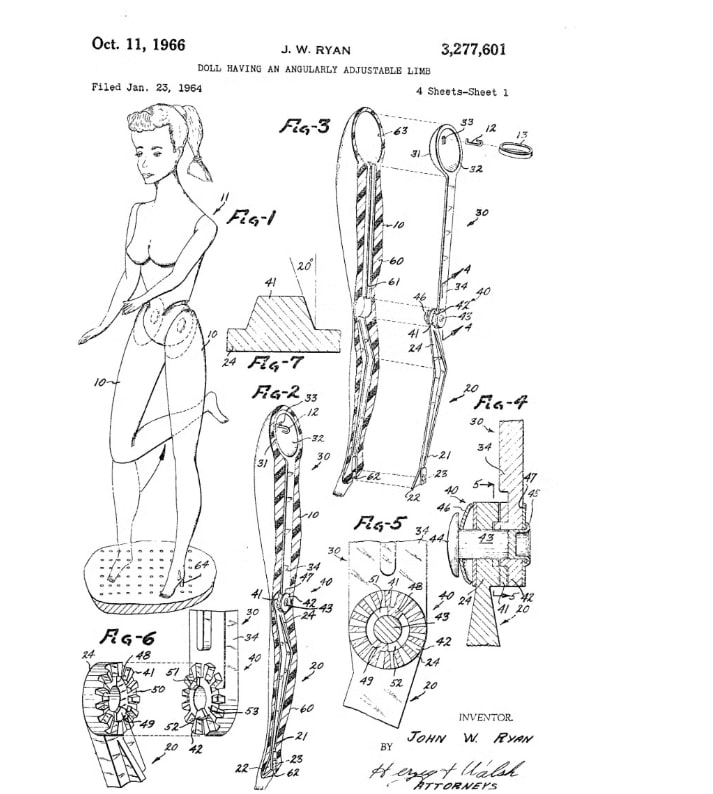
When Ryan first met with Ruth and Elliot Handler, the co-founders of Mattel, to discuss work opportunities, he negotiated a contract that stipulated that he would be an independent contractor who ran their Research and Development (“R and D”) division. In return, Ryan would earn 1.5 percent of the gross of products he designed for Mattel. By the following year, he filed a U.S. Patent for a mechanism that became the basis for the company’s Thunder Burp Machine Gun, a realistic-looking plastic toy weapon that produced a distinct sound when one squeezed the trigger.
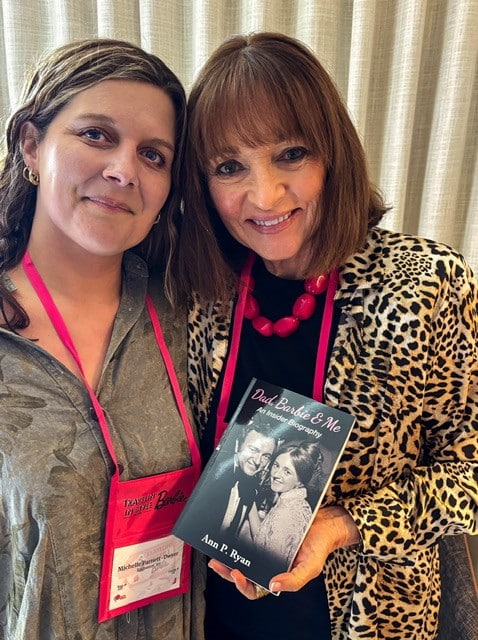
That same year, Ruth returned home from a European trip with a Bild Lilli fashion doll based on a glamorous, resourceful character from illustrator Reinhard Beuthein’s German comic strip. The doll initially sold as a novelty gag gift, but the manufacturer increased sales by marketing the doll and additional fashions as playthings for girls. Ruth wanted to create a similar doll for the American market and handed Bild Lilli over to Ryan. In Ann P. Ryan’s book Dad, Barbie, & Me: An Insider Biography, Jack’s daughter detailed her father’s analysis of the doll, which he believed would fail as a children’s toy. Ann wrote that her father “wanted fewer parts, cleaner lines, and materials that could withstand both production and play.” Jack’s technical precision, imagination, and direction, as well as a team including Elliot Handler, product designer Frank Nakamura, costume designer Charlotte Johnson, and engineer Seymour Adler, among others, led Mattel to the successful launch of Barbie in 1959.
In October 1962, Time published “All’s Swell at Mattel.” By that time, the company had a staff of 200 toy developers, including chemists, sculptors, and engineers, with an annual budget of $1,500,000. Ryan told Time, “We’re right out on the frontier of technology.” He certainly was. While at Mattel, Ryan engineered the voice mechanism for the Chatty Cathy doll, oversaw the development of Barbie with a Twist ‘N Turn waist, contributed to the development of Hot Wheels toy cars, and secured hundreds of patents.
By the mid-1970s, Ryan had left Mattel. He filed a lawsuit against the company for breach of contract. They reached a settlement in 1980, but Ryan’s physical and mental health declined during the vicious legal battle. Many scholars and journalists have explored Ryan’s life and his contributions to Mattel in books, such as Toy Monster: The Big Bad World of Mattel by Jerry Oppenheimer and Forever Barbie: The Unauthorized Biography of a Real Doll by M.G. Lorde. While these publications are critical and, at times, salacious, Ann’s book about her father is both diplomatic and personal. It provides the reader with a unique perspective on the creator, his influence on the toy and doll industry, and the impact his career had on his own children.
With special thanks to generous museum donors, Robin Wyatts and Bradley Justice Yarbrough, I had an opportunity to travel to a few Barbie-related events this summer where I got to spend time with Ann. I am grateful to Ann and her willingness to share her story. These accounts help us to preserve the history of play in significant ways that aren’t typically familiar to those of us who rolled a Hot Wheels car down the driveway or slipped a new pantsuit on Barbie. I also learned that me and Ryan have the same birthday. So, this November, I will light an extra candle on my cake in honor of what would have been his 100th birthday.

