



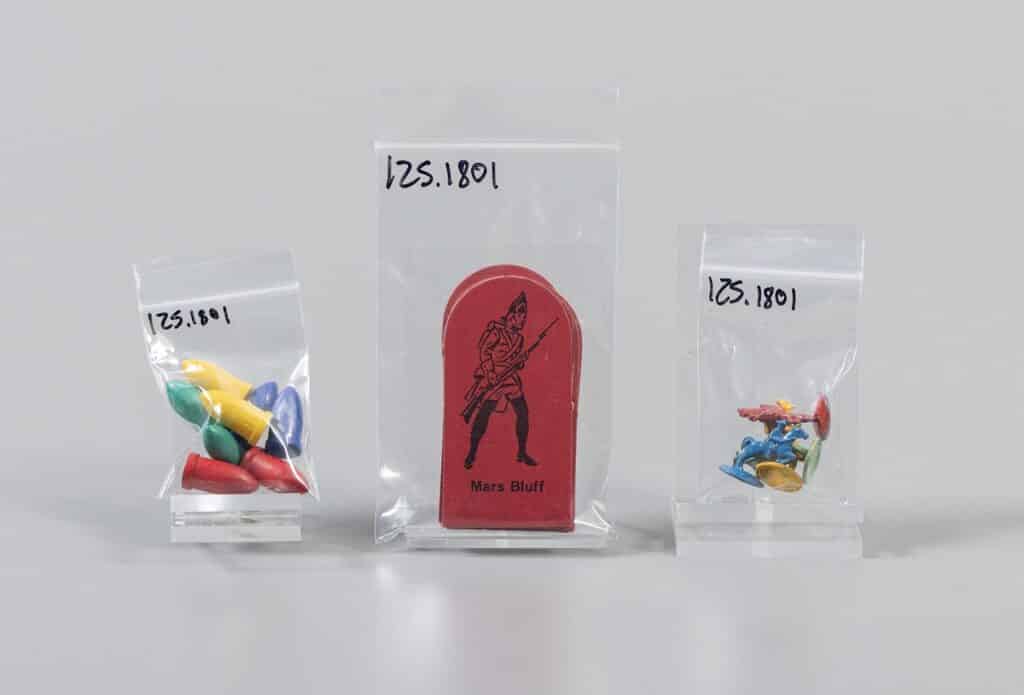
The year is 2013. I’m in my college dorm, putting little board game pieces into bags. The year is 2026. I’m in my office, putting little board game pieces into bags. The more things change, the more things stay the same. But these bags are archival polyethylene, I’m wearing nitrile gloves, and I might be overthinking it.
As one of The Strong’s curators, I decide which board games and puzzles are added to the museum’s collections. Once they’re added, I’m responsible for cataloging many of them. In this series of two behind-the-scenes blogs, I’ll provide long-awaited insight into the arcane process of cataloging board games. I set out to write a blog covering the procedure from start to finish, but my section on bags got so long that I had to spin it off. In the next one, I’ll go over how I input board games into our database and explore the challenges of categorizing analog games.
While we typically treat board games as a singular object, anyone who has misplaced a crucial piece knows that isn’t really the case. Each box is a treasure trove of cards, tokens, and dice, and game owners care deeply about these pieces. If you’ve ever cringed watching someone riffle shuffle a deck or absent-mindedly bend their hand of cards, you’re in good company. For some players, this care for pieces extends beyond the bounds of a play session. In their article “I Love All the Bits,” scholars Melissa Rogerson, Martin Gibbs, and Wally Smith found that players enjoy spending time organizing, protecting, and even customizing their game components. One such activity, colloquially referred to as “bagging,” means organizing a game’s myriad pieces into bags.
A Bag of Marbles?
At a surface level, my cataloging process resembles the hobbyist’s bagging. We share many of the same goals, after all. Rogerson et al. describe how owners bag pieces to protect them from damage or loss, two things that we certainly would like to avoid here at the museum. I write the game’s object ID number on each bag just in case it gets separated from the rest of the game. Other hobbyist motivations are less relevant to my work, however. Bagging can make it easier to get a game started. For instance, players might keep all of cards and tokens belonging to each player inside that player’s bag to prevent having to individually distribute those pieces at the start of every game. Having recently spent an hour simply setting up for what would become a six-hour session of Frostpunk: The Board Game, I can see the utility. As the museum’s games are not available to play in the same way, though, my priorities differ. My goal is long-term preservation.
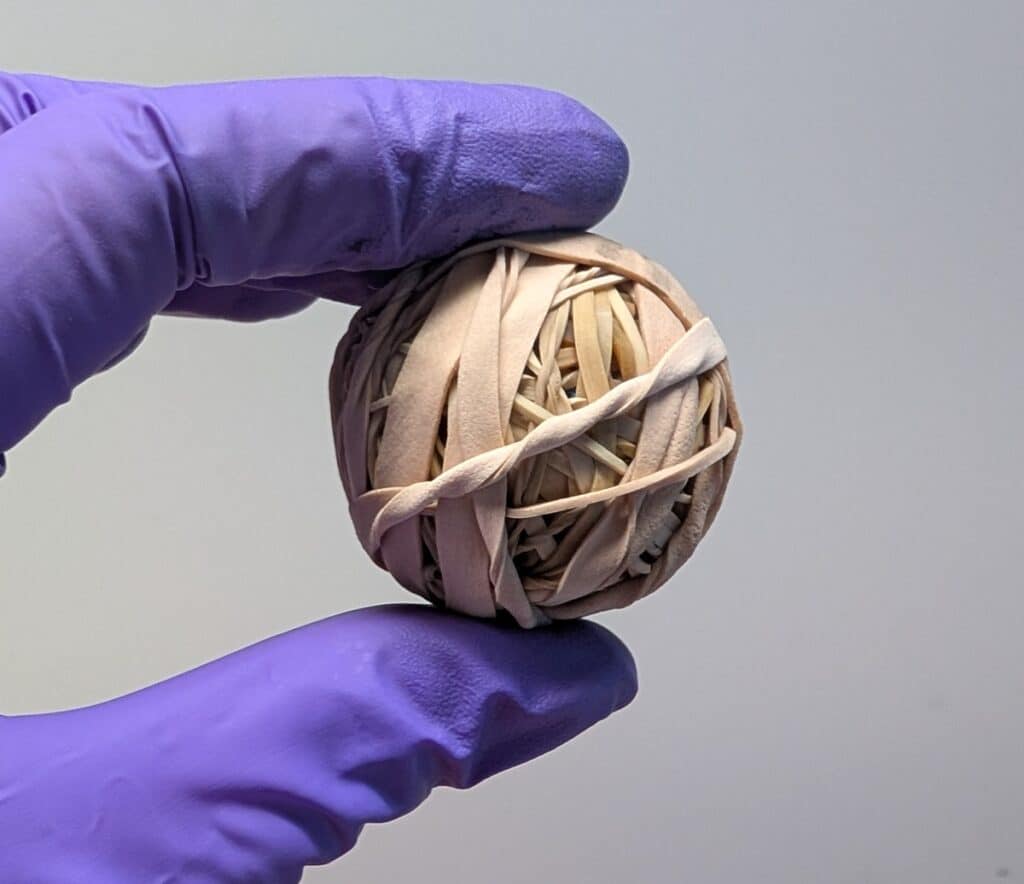
When we add an object to our collections, we accept responsibility for it in perpetuity. Even games that seem ubiquitous now may not be nearly as accessible decades down the line. But the variety of tactile materials that bring board gamers such delight can make preservation difficult. All materials degrade over a long enough time scale, but this does not happen at the same rate or with the same effects. I’m no conservator, but I have encountered the stickiness of deteriorating plastic and the frustrating crustiness of old rubber bands (please don’t wrap your cards in rubber bands). While players might accelerate setup by storing plastic miniatures and cards in the same bag, the game curator of the year 2200 will curse my name if I make them pry gooey plastic from cardstock. So, I separate the pieces by material so that they do not disrupt each other’s degradation processes. Easy. Cards in one bag, painted wooden tokens in another, maybe a third for plastic bits. Rulebooks and advertisements for other games get placed in nice mylar sleeves.
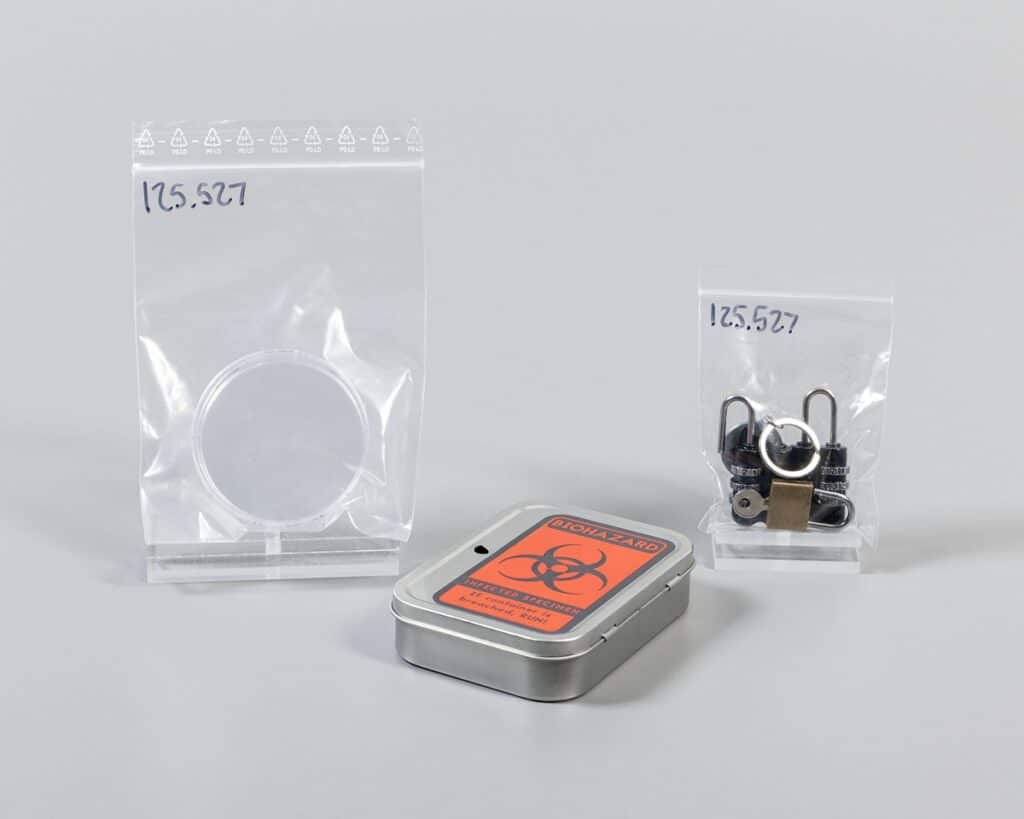
It’s not always that simple, however. In some games, storage serves an important gameplay function. Tabletop escape games feature locked boxes filled with clues and tools, and players only gain access to these as they solve puzzles. Removing those pieces from their boxes and sequestering them in bags removes crucial context for how the game functions. Luckily, games like Escape Room in a Box: The Werewolf Experiment have online instructions on how to reset the game pieces to their original arrangements. These instructions may not always be available, however, so I’ve uploaded a copy to the game’s entry in our database. More problematic still are legacy-style games like 2015’s Pandemic Legacy Season 1. Like escape games, these typically involve opening sealed components throughout the game. Worse, these games often instruct players to destroy game components during play. Unlockable components and destruction make each group’s copy unique, but what a nightmare for preservation. As I speculated at 2023’s GENeration Analog conference, there could be entire archives dedicated to played copies of a single legacy game.
Not Really My Bag
Legacy games are an extreme example, but they raise an important question: do the particularities of a specific copy of a board game matter? The games are mass-produced, but ownership leaves a mark. Books are a good comparison. In The Strong’s Brian Sutton-Smith Library and Archives, we have many annotated books from the personal library of Sutton-Smith, the library’s namesake. These books are important both because of their printed content and because of the history of who owned them, a concept that museums like The Smithsonian call “provenance.” I haven’t encountered many rulebooks with notes scribbled in their margins, but provenance is relevant to board games as well. There’s a related concept from archival theory called “original order.” The idea is that how an owner organizes their things tells us something about that owner, so that order should be respected when possible. In the case of board games, the organization of the pieces may provide insight into the prior owner’s thought processes.
For many research projects, the way I bag the components is not particularly relevant. Projects examining how games have historically represented girlhood or generated humor draw primarily on the games as published. It’s difficult, though, to predict what other researchers might be interested in studying. Researchers approach games and play from an astounding number of disciplinary angles. The museum’s research fellow program attracts historians, film scholars, computer scientists, and medical practitioners. I would like our board game collection to serve as many of them as possible. For many projects, any copy of a game will suffice. Other researchers, however, might instead focus on board game players and collectors themselves.
As studies like Rogerson et al.’s show, there is scholarly interest in researching board gamers’ practices. Today’s players and collectors are available for interview now, but there may come a day when the best evidence of their organization principles is found in their games themselves. Our museum is well positioned for this type of research because so much of our board game collection comes to us directly collectors. In their article “Repacking My Library,” scholars Carly Kocurek and Jennifer deWinter demonstrate how institutions like The Strong are indebted to collectors for safeguarding rare games and for selecting the museum to preserve those games long-term.
A Mixed Bag
Bagging, then, has become a thornier issue for me. How can you best preserve a game’s material components while respecting how the previous owner organized them? Sometimes, this means a silly cascade of bags within bags, erecting barriers between unlike materials while keeping groups of items together. I’ll take this approach if I suspect that the provenance is particularly impactful. For instance, I’ve cataloged hundreds of games from the Herb Levy collection. Levy was a game collector and the founder of the newsletter and website Gamers Alliance, and he gave over 3,000 games to the museum. Cataloging through the games, I find evidence of his careful stewardship. Small slips of paper with a handwritten “Complete” lie in many of the boxes, demonstrating the care he took to ensure the games had all their pieces. Processing games in this way may provide insight into the life of such an avid collector, player, and writer.
Other times, the game’s prior owner was its creator. Board game designers typically go through several drafts of games before pitching them to publishers. Mass-produced copies are largely similar to one another, but prototypes are unique from the start. This is another case where I will take special care to maintain the box’s organization. Maybe the designer thought this arrangement of pieces would be most appealing to publishers. Maybe it just made it faster to playtest. Scholars interested in creators and their design processes might benefit from my careful attention to the game’s organization.
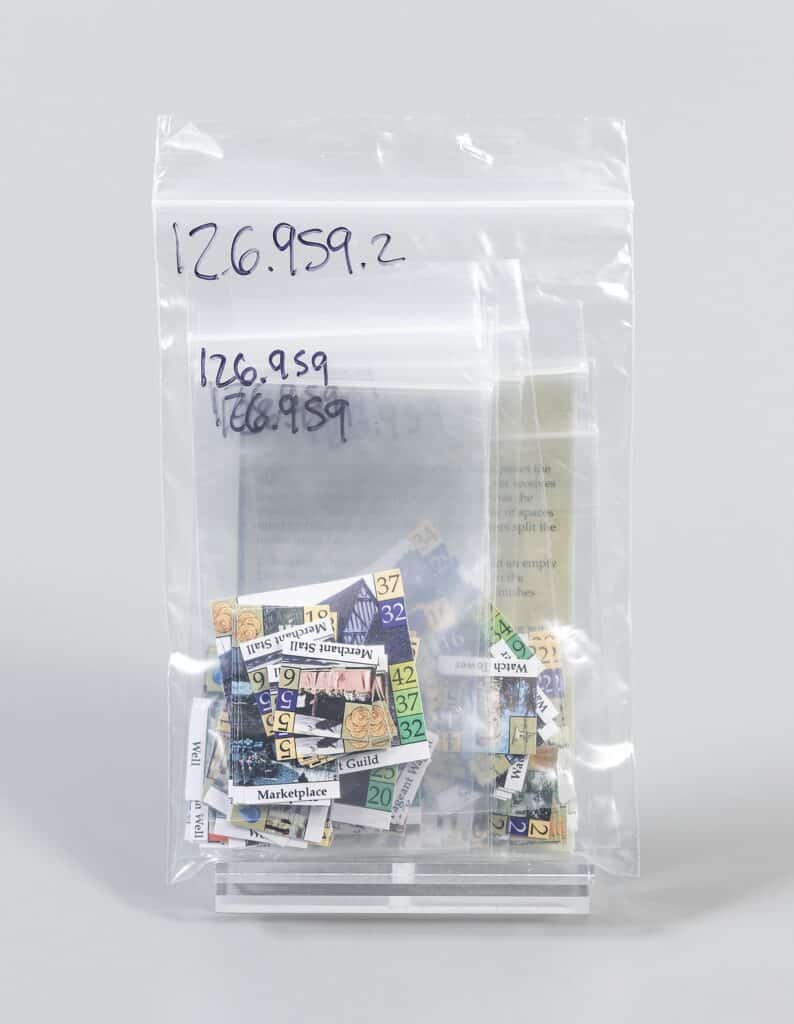
Following this logic to its extreme, though, things get quickly out of hand. Must I preserve the exact shuffle of the cards as we received it? Does it matter how the bags are arranged in the box? I’ll often open a box to find a total disaster: cards, play money, and cardboard chits scattered across the box bottom. I can’t just leave it like that. We get new or unopened games, too. Might a theoretical future researcher be interested in how the pieces were arranged in their original packaging during the manufacturing process? Perhaps. In these cases, though, I will typically prioritize separation of materials over the original order. As Michelle Caswell argues in “’The Archive’ is Not an Archives,” scholars in recent decades have critiqued concepts like provenance and original order in part by drawing attention to the subjective decisions that archivists must constantly make while processing materials. I have my own biases, and the way that I approach this problem may change over time.
I never thought I’d be bagging in a professional context. Now I take a deep breath before cataloging a hobbyist board game because I know it’s going to have roughly one million pieces to bag. Cataloging games can seem like a rote process, and it often is one. I’m often asked if this job has killed my enthusiasm for board games. It absolutely has not. But my relationship with plastic bags will certainly never be the same.

