




Inducted: 2026
Italians played Lo Gioco del Lotto d’Italia in the year 1530. In France, games with playing boards, tokens and the calling out of numbers appeared in the 1600s, and the game made its way to Spain as well. In 19th-century Germany, similar games taught spelling and animal names to children. The name “loto” or “lotto,” came into use and is still the preferred name for the game in much of Europe. And educational lotto games for children continue to be sold in the United States. A Spanish version, lotería, was brought to colonial Mexico as early as 1769. Lotería is based on matching images, not numbers, and its callers sometimes introduce each card with a poetic verse. First played by the upper classes, lotería became popular at fairs across the country and the game and its images have become iconic in Mexican culture.
In the 1920s, Pennsylvanian Hugh J. Ward brought the game beano—played with dried kidney beans on printed cards― to play at fairs and carnivals. The toy merchandiser Edwin S. Lowe (later of Yahtzee fame) saw the game and showed it to some New York friends. Lowe called his version “Bingo,” and it caught on and spread throughout the country by the 1940s. Legend says the name bingo came about when one of Lowe’s friends yelled it by mistake while playing beano.
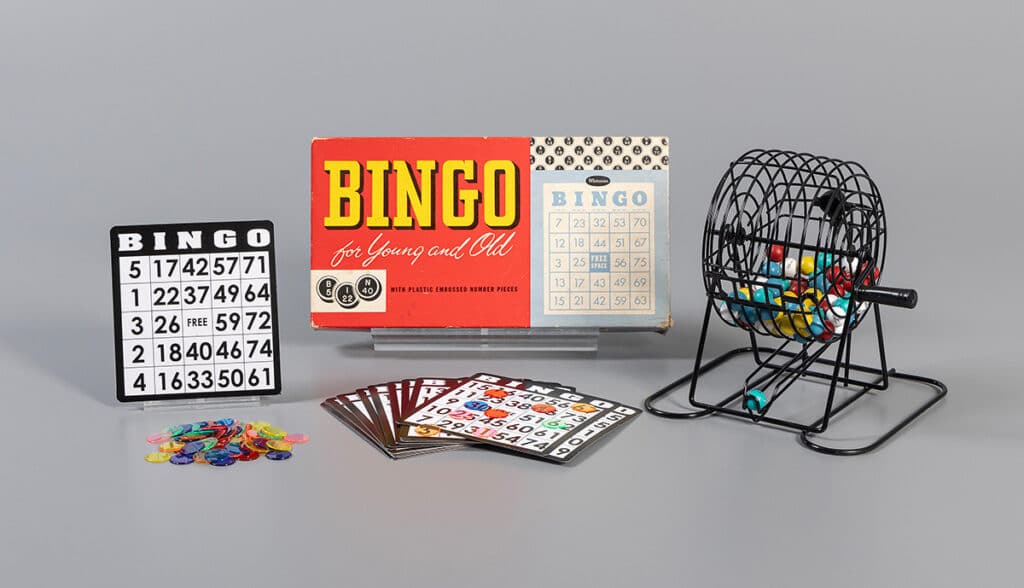
While variants of the game continue to emerge, traditional American group bingo is usually played with 75 numbers, pulled at random and called out. Each standard game card has 25 numbers, arranged in equal columns under the letters “B, I, N, G” and “O,” with a free space in the center which is considered automatically filled. Players mark the number called upon their cardboard or paper game card, usually with ink stamps. The range of numbers appearing under each letter is restricted, with numbers from 1-15 found under “B,” etc. A player shouts “bingo!” when a column, row, or diagonal line of numbers is filled—and the first to do so wins the largest prize. Playing the game is simple, and many players hold multiple cards to increase their odds of winning. But beyond the simple standard game, multiple variants exist in card types and arrangement, as well as numerous different ways of winning a game.
One cannot discuss bingo without mentioning the educational merits of its progenitor, lotto. While Lotto, like bingo, is traditionally played with numbers, variants of the game use picture cards to teach children the names of animals, places, and things of all kinds. Lotto’s number/word/image matching concept is adaptive to multiple learning styles in many subjects. Bingo games are also used to teach language basics to children and adults in United States, as well as English as a foreign language in many countries.
While bingo is now often associated with an older audience, it has become increasingly popular with young adults. Recently, public bingo games have gone beyond fundraising and have become popular in bars and nightclubs. Electronic bingo games have their fans and casinos now feature slot machine bingo games where it is legal. Interestingly, Western New York, especially the area around Buffalo, is believed to have the highest concentration of bingo halls in the United States.

