



As I prepare to leave The Strong after 37 years on the museum’s curatorial staff, I’ve been reflecting on highlights from my career. The museum has seen incredible changes over those decades and moved from a sleepy museum focused on how everyday Americans lived between 1820 and 1940 to a vibrant institution that draws more than 600,000 guests every year to explore the ways play has changed lives through American history and continues to transform all of us each day.
As exciting as participating in that evolution has been, perhaps what’s been most memorable for me have been trips with my colleagues to pack up and transport significant additions to the museum’s collection. Don’t get me wrong—I’m hugely grateful for every donor who kindly offers to box up and ship their collection to us. But it’s a special challenge and, frankly, a bit of a special thrill to go there in person to make the pickup.
Lady Liberty Hits the Road
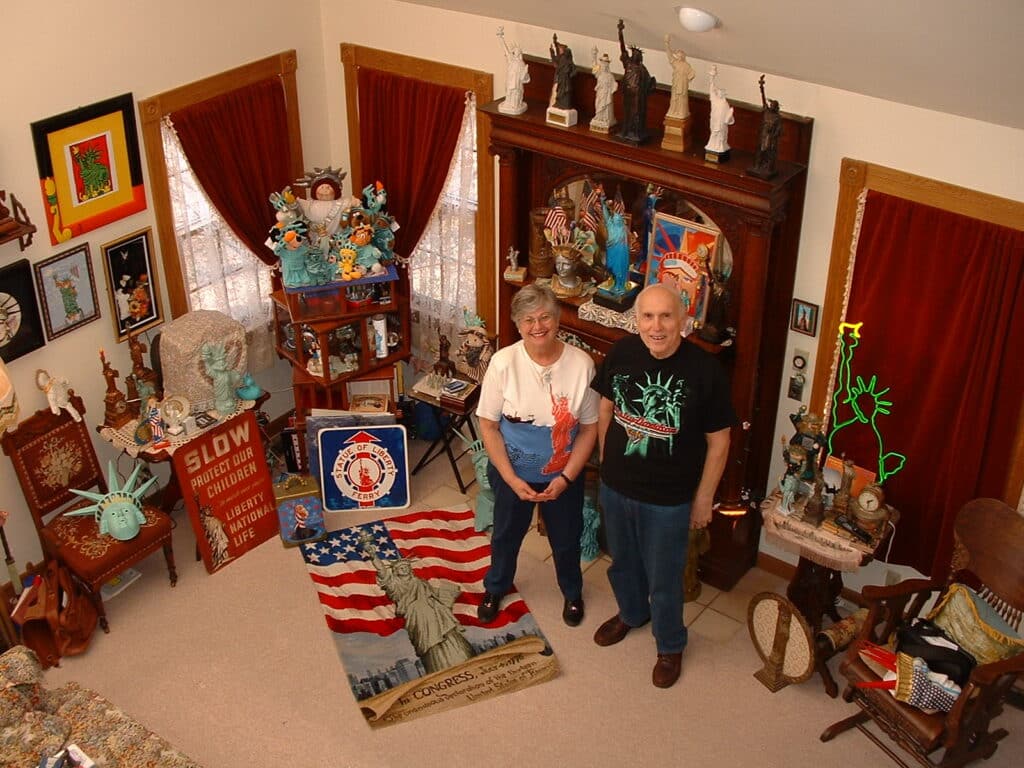
It was back in the early 2000s that the museum was contacted by Iris and Mort November, a lovely couple from Cleveland. Iris had amassed a massive collection of items related to the Statue of Liberty and filled their summer home on the grounds of the Chautauqua Institution. Our initial visit to Chautauqua proved to be a little boggling. Statue of Liberty steins and candlesticks? Absolutely. Statue of Liberty dolls and stuffed animals? Sure. But I never envisioned Statue of Liberty branded canned fruit cocktail, let alone plastic high-heeled sandals with the Statue of Liberty sloshing along in miniature snow globes in the heels. First lesson for me—the quantity is usually larger than the collector thinks. In this case, The Strong ultimately added more than 1,600 objects from the Novembers’ collection. Second important lesson—always rent a bigger truck than you might think. I vastly underestimated how much space all those Statue of Liberty items would occupy, especially once they were padded and packed into boxes. It far exceeded the capacity of the panel van I’d misguidedly rented to haul the booty back to Rochester, requiring the curatorial team to make a return trip to pick up the remainder. The upside of a follow-up trip? The Novembers were incredibly hospitable and always fed us lunch.
Jan Berenstain’s Basement

Not too long after its 2006 expansion, The Strong developed a relationship with the Berenstain family as we planned an exhibit built around the Berenstain Bears books. Not only did a charming and long-running exhibit result, but Jan Berenstain and her son Michael kindly offered a donation of all sorts of Berenstain Bears products as well as the drawings for hundreds of “It’s All in the Family” cartoons that Stan and Jan produced for McCall’s magazine and later Good Housekeeping. This time, I benefited from experience and took a bigger truck and a larger crew of colleagues. But what I hadn’t counted on was the topography of Jan’s driveway on a narrow country road in southeast Pennsylvania, which necessitated us driving headfirst up to the house rather than backing up the drive. Hmm, that’s when I realized we couldn’t reasonably back up the steep driveway to the road. You haven’t had fun on the job until you’ve explained to a famous author and illustrator that you’re going to need to execute a K turn on her soggy front lawn to extricate our U-Haul truck. Fortunately, Jan was a kindly person who wasn’t too obsessed with the state of her grass because we left some rather large tire divots in the process of maneuvering the truck so that we could gun the engine, get up the hill to the road, and not overshoot into the ditch on the other side. Mission accomplished. Whew!
A World in Miniature
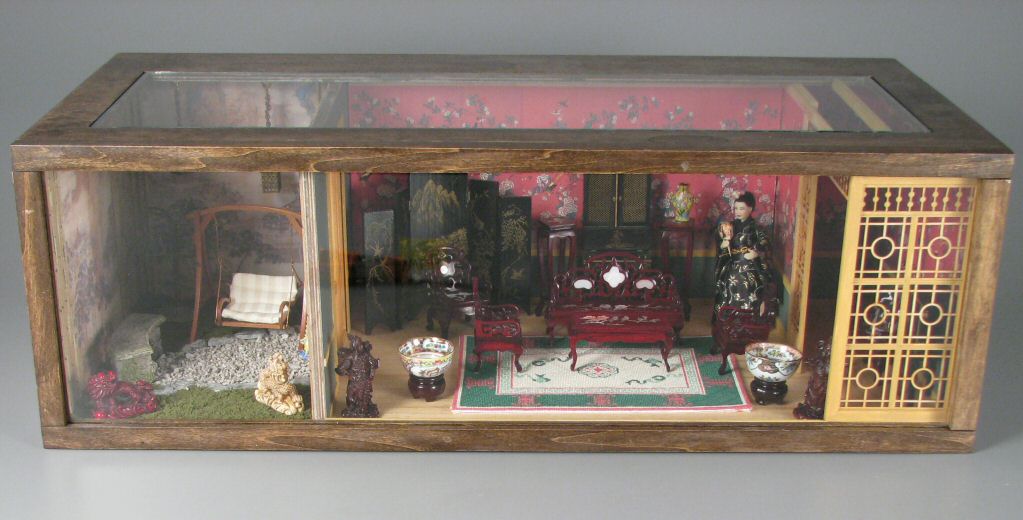
A few years later, the widower of a woman named Ruth Rosenfeld reached out to the museum from his home in Concord, Massachusetts. Ruth had been a world traveler, visiting more than 100 countries in her lifetime. But she didn’t settle for snapshots or postcards to remember her trips. She came home and assembled miniature rooms that evoked the places she’d been, from India to Japan to Monet’s kitchen. With our founder Margaret Strong’s love of dollhouses, Ruth’s miniature rooms sounded like a perfect way to bring the story of adult hobbies into the recent past. What I hadn’t completely factored into our packing plans was that nothing inside the dozens of miniature rooms was affixed. Every teensy chair, picture, dish, and tchotchke needed to be carefully packed and kept associated with the room structure itself. And, prior to packing, we needed to be sure to photograph each room so that we could restore it to its original appearance back in Rochester. I’d rented a sizable truck this time and brought a team of five, but it still felt a bit like one of those dreams where you’re running but you never make any headway. I’d allocated three days for the task and, at the end of day two, I was sure that we’d never meet our deadline. Meanwhile, the truck was rapidly filling with completed boxes. Yikes! But all my packing nightmares were for naught and, at the end of the final day, we had just enough room on the truck to insert a huge dollhouse of Ruth’s and roll down the door for the trip home.
Erector Sets and LEGO
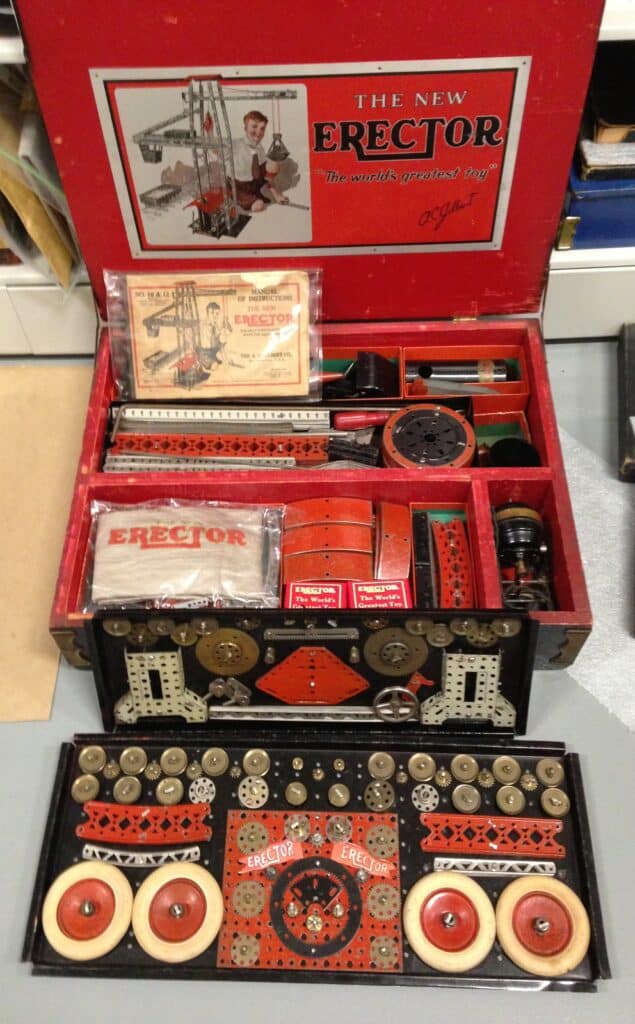
Fast forward to 2016 when the museum acquired a massive collection of construction sets from George Wetzel who lived a bit south of Chicago. Our toy curator had scouted the situation, so I knew we had our work cut out for us. I’ve learned that very few collectors keep their collection by the front door, convenient for a museum to swoop in and ferry off the goods. No, in this case, the collection was largely in the basement or the third-floor attic. And, short of toy company catalogs printed on glossy paper (that’s a story for another day), there’s hardly anything heavier in our business than an Erector Set with all those little metal pieces tightly packed into a well-made wood or metal box. To magnify the matter, George had a copy of the largest Erector Set ever made, weighing about the equivalent of a small car. In planning the packing team from the museum, I made sure to recruit a couple strapping younger colleagues who could endure the lifting and all the steps it would require. This time, packing up more than 1,000 construction sets blew through so many cardboard boxes that I had to place an emergency order for more boxes to be delivered the following day. And we all certainly got our daily quota of steps. In fact, the pedometer on one of my colleagues’ phones told him on the first day that he’d walked the equivalent of climbing to the top of the 110-story Willis Tower in nearby Chicago—three times! Who says that museum people aren’t tough?
But I could go on and on—so many acquisitions, so many tales of adventure and ingenuity as we confronted fresh challenges. My colleagues and I also met a wide array of fascinating collectors in their habitats and learned so much from them. The donations that we transported have helped expand and enrich the story of play that The Strong is dedicated to telling for the benefit of current and future generations. Doing interesting work with nice people for a cause I believe in—no wonder I’ve stuck around for more than three decades.
